Reserve Fund for Replacements Accounting in HUD-Financed Properties
HUD mandates strict rules for reserve deposits, draws, and audit approval on multifamily loans.

Reserve fund for replacements accounting in HUD-financed properties runs on a set of rules the owner does not get to write or waive. This piece walks through that structure from the ground up: how the deposit gets sized, what the money can and cannot touch, how a draw clears, and what an auditor is required to check before signing off.
Why HUD reserve fund accounting is governed by regulation
Most owners, when they first encounter the reserve for replacements line on a HUD-insured property's balance sheet, treat it the way they'd treat any savings account set aside for a rainy day: money they control, money they can tap when a judgment call says it's time. That instinct is wrong, and the Regulatory Agreement signed at closing says so directly. The fund, whether it sits as a cash deposit or gets invested in obligations of, or fully guaranteed by, the United States, must at all times remain under the control of the mortgagee. That language comes straight from HUD Handbook 4350.1, Chapter 4, and it is not a suggestion.
Two funding streams build the account from day one: a lump-sum deposit made at closing, and monthly deposits folded into the regular mortgage payment. Neither is optional. HUD multifamily loans have to put in at least $250 per unit per year in required replacement reserve deposits, and that floor applies no matter how an owner might prefer to allocate cash in a given year. The money goes in on a schedule set by the loan documents, and it comes out only through a process HUD controls.
What this means for how the reserve gets accounted for is simple to state and easy to underestimate: every later rule in this piece, the eligibility line between capital and maintenance, the HUD-9250 draw process, the audit procedures, flows from this one fact. The reserve is a lender-controlled escrow created by contract, and the owner's job is to operate within boundaries someone else drew.
HUD's deposit sizing: loan type and the PCNA
Deposit amounts are not the same across every HUD-insured deal. They vary by loan type and get calibrated at underwriting based on two things: the property's actual physical condition and its projected capital needs over time. The $250 per unit per year figure for multifamily loans, including HUD 223(f) loans, is a floor, not a target. If a property is older, with aging boilers and a roof nearing the end of its service life, it will need a higher required deposit than a newly built property still under warranty.
The number that ends up in the loan documents, both the initial deposit at closing and the ongoing monthly contribution, comes out of the Project Capital Needs Assessment, usually shortened to PCNA. This assessment schedules the property's expected capital expenditures across a twenty-year horizon, and it matches projected system failures and replacements against a funding plan so cash is there when the work actually needs to happen. For an owner weighing deal structure at closing, this is not a paperwork exercise to skim past. The PCNA determines how much cash gets locked into the reserve for two decades, cash that could otherwise support debt service coverage or distributions. Getting the physical condition assessment right, and understanding how its findings translate into deposit requirements, shapes the project's cash position for the life of the loan.
Interest earned on the reserve follows the same logic of control that governs the principal. It can never be paid out directly to owners or to individuals associated with ownership. HUD encourages, and in some cases requires, that interest earned stay in the account, and retention is mandatory for certain Section 8 projects. The interest flows through the project's own accounts, not into anyone's pocket. That rule is a small detail with a large implication: even the earnings the reserve generates operate under the same mortgagee-control logic as the deposits themselves, reinforcing that this fund runs by a different set of rules than ordinary project cash.
The capital-versus-maintenance line
The single most consequential accounting decision an owner makes on a HUD-insured property, more consequential day to day than the size of the deposit, is deciding whether a given expense qualifies as a capital replacement eligible for reserve funding or counts as routine maintenance that has to come out of the operating budget. HUD draws this line explicitly, and the test it applies comes straight from Handbook 4350.1: does the expense replace or substantially restore a major building component at or near the end of its useful life, or does it cover the kind of routine upkeep a property performs in any given year?
Items that traditionally qualify for reserve funding include full roof replacement or major roof work covering gutters, downspouts, and soffits; replacement or major overhaul of central HVAC systems, including boilers, chillers, cooling towers, furnaces, and fuel storage tanks; major plumbing and sanitary system repairs; elevator system overhaul; major repaving, resurfacing, or sealcoating of sidewalks, parking lots, and driveways; repainting the entire building exterior or extensive siding replacement; extensive replacement of exterior sprinkler and irrigation systems; swimming pool replacement or major repair; major appliances replaced extensively across the property; extensive replacement of kitchen and bathroom fixtures such as sinks, countertops, bathtubs, and toilets; and extensive replacement of exterior and interior doors.
Set against that list, a parallel set of items must be paid from operating funds, never from the reserve: interior repainting of units or common areas; appliance components like range burners, oven elements, controls, and valves; window-unit air conditioner parts such as fan motors and compressors; minor HVAC repairs like valve replacement or boiler cleaning; minor roof, gutter, and paving repairs; caulking, sealing, and window and screen repairs; maintenance tools and minor office equipment like mowers and snow blowers; and fire-extinguisher inspection, recharge, and other routine maintenance.
The pattern that separates these two lists comes down to scope. Replacing all the ranges across a property is a capital expense eligible for reserve funding. Replacing a single burner element inside one range is maintenance, paid from operations, no matter how worn that element is. The same logic applies across every category on the list: property-wide, systemic replacement qualifies; an isolated fix on one unit does not, even when the isolated fix addresses the exact same component.
Capital improvements that go beyond restoring something to its original condition can still qualify for reserve funding, but only if HUD agrees the improvement enhances mortgage security, strengthens the property's position in its market, or responds to a change in law. These draw more documentation scrutiny than straightforward like-for-like replacements, because HUD has to approve something beyond simple restoration. Accessibility modifications required under the Americans with Disabilities Act and fire-safety upgrades mandated by code changes both fall under this capital-improvement standard and are eligible on that basis. HUD also expects owners to weigh energy efficiency when they're already replacing an eligible item: Energy Star-certified replacements are permitted and encouraged, and reserve funds have been allowed for green retrofits, including the installation of green roofs.
How a draw gets approved, the HUD-9250 process
Knowing that an expense qualifies for reserve funding solves only half the problem. Getting the money released is not a matter of calling the loan servicer and asking for a transfer. It requires HUD's written approval before a single dollar moves, and that sequence catches first-time borrowers off guard more often than any other part of reserve administration.
The requirement traces back to the same Regulatory Agreement that puts the reserve under mortgagee control. That agreement bars any disbursement without HUD's written consent, so the request has to route through HUD itself. You make that request on Form HUD-9250, Funds Authorization, and you should always work from the current version as hosted on HUD's own site, not an older copy saved from a previous transaction.
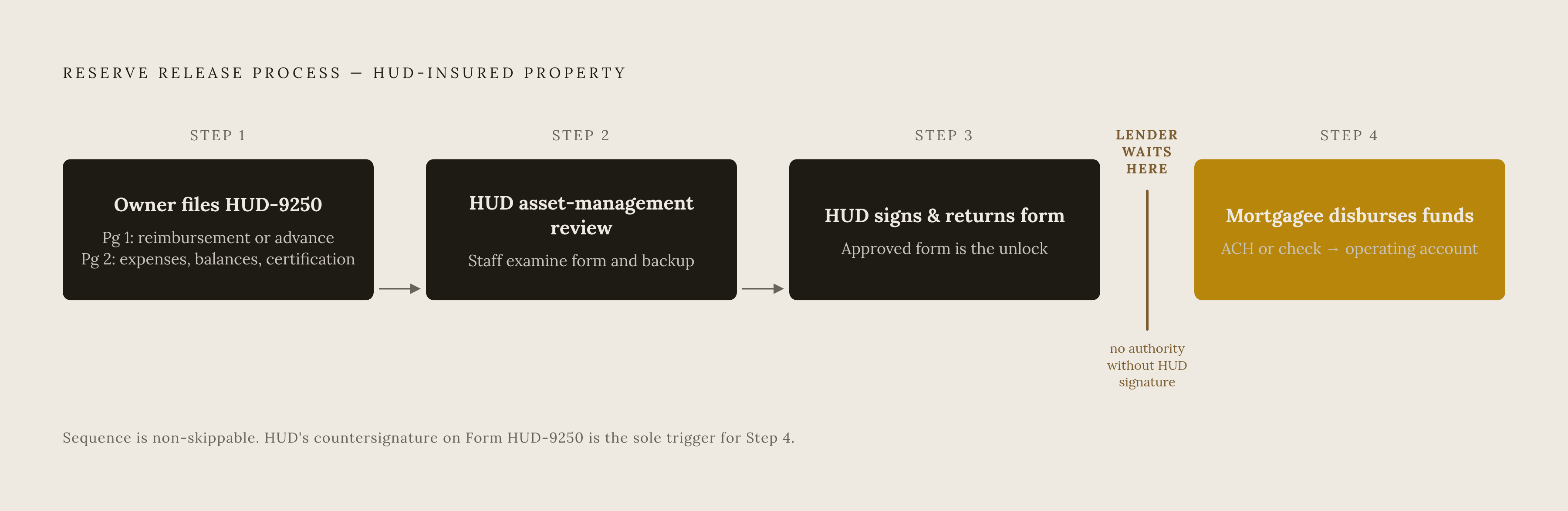
The form itself runs in two parts. On the first page, the owner indicates whether the request is a reimbursement for work already completed or an advance for work about to start. On the second page, the owner itemizes each expense: its purpose, its amount, and the current balance in the reserve account, then signs the owner certification attesting that the information is accurate.
From there, the completed form goes to HUD, where asset-management staff review it. If approved, HUD signs the form and returns it, authorizing the release. Only at that point does the mortgagee disburse the funds, typically by ACH or check into the project's operating account. Sending the form directly to the lender in hopes of speeding things along accomplishes nothing: the lender has no authority to release reserve funds without HUD's signed approval already in hand, regardless of how complete or urgent the owner's paperwork looks.
Timing on draws differs meaningfully by loan type. On new construction and substantial-rehabilitation deals, draws tend to be rare in the early years, since roofs carry manufacturer guarantees, appliances remain under warranty, and latent defects are typically covered by bonds. On HUD 223(f) acquisitions, which finance existing and often older properties, draws can happen at any time after Final Endorsement, because the property may already carry capital items nearing the end of their useful life when the loan closes.
Reserve draws are distinct from another cash event the Regulatory Agreement also governs: the annual distribution of surplus cash to owners. That distribution runs on its own test and its own calendar, separate from the reserve draw process, and the two should never be conflated when owners or their accountants are tracking cash movement on a HUD-insured property. The approval chain for a reserve draw is sequential, and no step can be skipped or reordered. It is the contractual mechanism built into the Regulatory Agreement to keep the reserve under mortgagee control from the day it's funded to the day it's spent.
Recording and reporting the reserve
One of the most common recordkeeping errors on HUD-insured properties with a Section 232 structure has nothing to do with eligibility rules or draw timing. It has to do with whose books the reserve sits on. In the Section 232 dual-entity structure, the borrower and the operator are distinct legal entities, and HUD escrow accounts, including replacement reserves, property tax escrows, and insurance escrows, belong on the borrower's books, not the operator's. Placing reserve activity on the wrong entity's books is an error that becomes visible at audit time and is far more disruptive to correct after the fact than it would have been to set up correctly from the start.
Beyond where the reserve sits on the books, HUD requires a specific deliverable each reporting period: the Supplemental Schedule of Reserve for Replacements. This schedule analyzes all replacement reserve account activity for the period, capturing deposits, draws, and interest credits, and it gets filed electronically through HUD's Financial Assessment Subsystem, known as FASS, administered through a HUD oversight office. For an owner preparing year-end financials, this schedule is a concrete, checkable deliverable: either it has been filed with accurate, complete activity for the period, or it has not.
The audited financial statements surrounding that schedule have to comply with HUD's Uniform Financial Reporting Standards, codified at 24 CFR 5.801 and 24 CFR 200.36. Beyond the basic financial statements, the auditor also has to submit a report on the consideration of internal controls, a report on compliance with specific requirements, and supplemental data reports. None of these are optional add-ons left to the auditor's professional judgment about what the engagement needs. They are fixed parts of the reporting package every HUD-insured property has to produce.
The audit trail procedures
The audit of a HUD-insured property's reserve for replacements does not work like a general review of account balances. HUD Handbook 2000.04, known as the Consolidated Audit Guide, prescribes the exact procedures an auditor has to perform, and that prescription is mandatory for audits of for-profit participants in selected HUD Housing and Ginnie Mae programs. There's no discretion built into this part of the engagement: the auditor checks a defined list of things, in a defined way, every time.
That list starts with the auditor obtaining an understanding of what the Regulatory Agreement actually says about establishing and maintaining the fund, since every other procedure that follows depends on that baseline understanding being correct. From there, the auditor determines that the reserve has been established in a federally insured depository approved by the mortgagee, with interest retained in the account as required. The auditor verifies all reserve account activity for the period under review, including every deposit, every draw, and every interest credit, and separately confirms that the deposits actually required under the loan documents were, in fact, made.
The procedure that ties the whole system together traces each disbursement from the reserve back to its associated HUD approval form, the HUD-9250 discussed earlier, and then back further still to the canceled invoices that support the expense. The auditor also traces disbursements to the client's general ledger and to the monthly or annual mortgage statements, then confirms the account balance and the year's reserve activity directly with the loan servicer as of the client's fiscal year end.
This procedure list makes clear that a draw approved through HUD-9250 sits in the middle of the paper trail, not the end of it. Every dollar that leaves the reserve has to be traceable forward to an invoice and backward to a signed HUD approval, confirmed independently against what the servicer's own records show. A gap anywhere in that chain, a disbursement without a matching 9250, an invoice that doesn't tie to the amount drawn, a servicer balance that doesn't match the general ledger, is a finding, because the entire structure of reserve fund accounting on a HUD-insured property exists to make that trail checkable from the day the Regulatory Agreement gets signed to the day the loan is paid off.
Sources
- CHAPTER 4. RESERVE FUND FOR REPLACEMENTS 4
- HUD Replacement Reserve Eligible and Ineligible Items - LegalClarity
- Funds Authorizations U.S. Department of Housing and Urban Development
- How to Prepare for Your First HUD Section 232 Audit
- Mortgagor’s Guide for Multifamily Reserve for Replacement Fund September 2020
- Real Estate Assessment Center Summary of Financial Reporting and
- Section 232 Handbook, Section II, Production, Chapter 3 Page 1
- March 12, 2019 MEMORAMDUM FOR: HUD Multifamily ...