Internal Control Deficiency Classification and Auditor Reporting Obligations
Auditors must separately assess likelihood and magnitude to classify control deficiencies correctly.

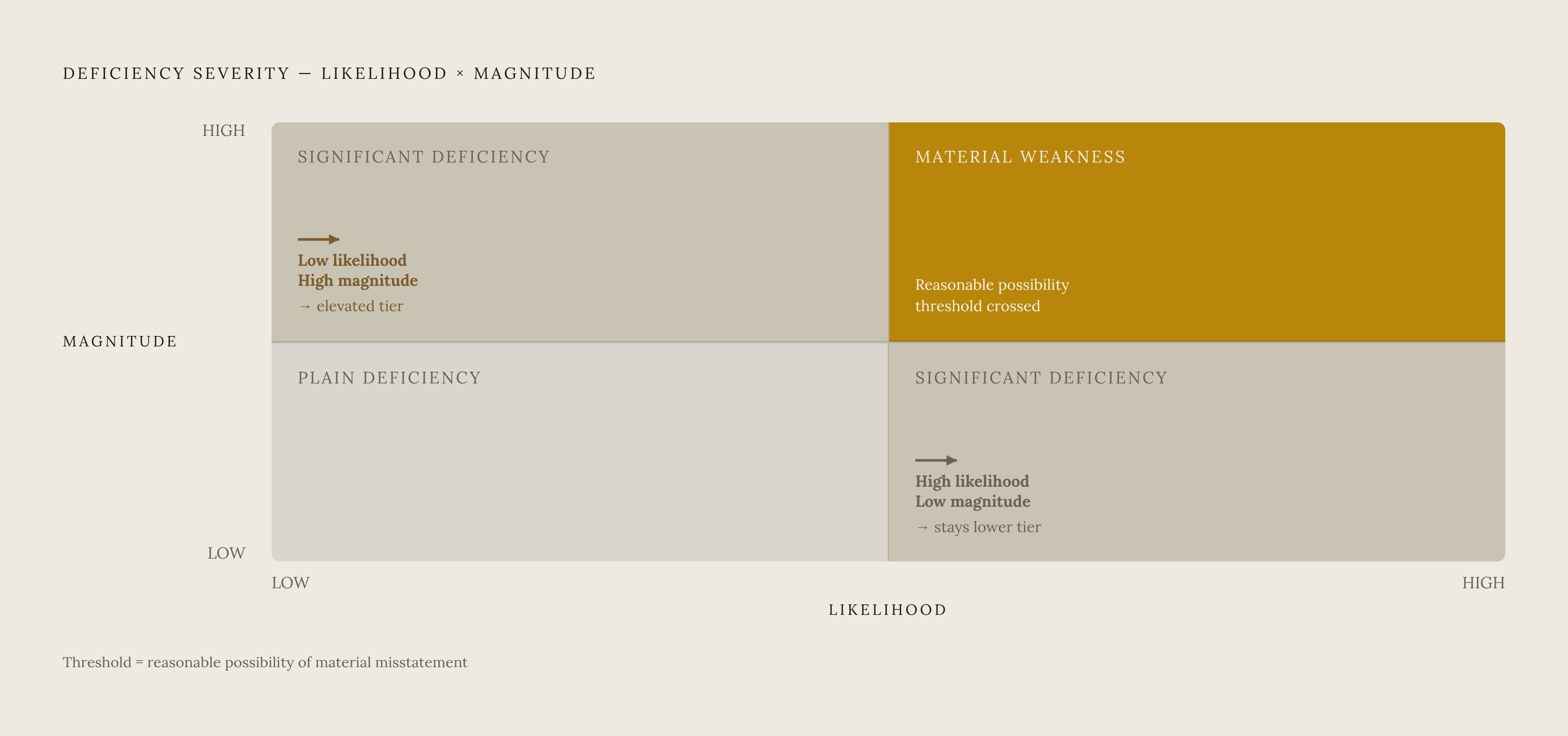
Classifying a control deficiency is not a matter of sorting findings into bins by size. A control deficiency's severity is determined by two independent dimensions, likelihood and magnitude, and the framework exists precisely because those two dimensions can move independently of each other. A control gap can be highly likely to produce an error that turns out to be small, or it can be a remote possibility attached to an account where any error at all would be large. The framework has to accommodate both situations, and it does so by placing every deficiency somewhere on a two-axis grid rather than a single scale.
Likelihood asks how probable it is that the gap in question will actually let a misstatement slip past undetected. Magnitude asks a separate question: if a misstatement does occur, how big could it get relative to materiality? Those two answers, considered together rather than in isolation, decide whether a finding stays a plain deficiency, rises to a significant deficiency, or reaches material weakness. A deficiency with low likelihood and low magnitude might not warrant a second look. One with high magnitude potential, even if the probability of it firing is modest, can still justify elevated treatment. An auditor cannot classify severity by applying a fixed dollar threshold alone, because the two axes interact. Getting that placement wrong is not a cosmetic labeling error. Because the tier assigned to a deficiency carries a specific and different reporting consequence attached to it, a misclassification changes what gets communicated, to whom, and under what obligation, which makes it a substantive audit failure rather than a matter of phrasing.
The baseline definition under AS 1305: a deficiency exists when the design or operation of a control does not allow management or employees, in the normal course of performing their assigned functions, to prevent or detect misstatements on a timely basis. A deficiency in design means the control itself is missing, or it would not meet its stated objective even if every person executed it perfectly. A deficiency in operation means the control was designed adequately, but it is not functioning as intended, perhaps because the person responsible lacks the authority or the qualifications to carry it out. A design flaw requires redesigning the control. An operating flaw requires retraining, reassigning, or re-empowering the person running it. Neither fix is interchangeable with the other, and an auditor who conflates the two risks recommending the wrong corrective action entirely.
A significant deficiency is defined as less severe than a material weakness, yet important enough to merit attention by those charged with governance. A significant deficiency occupies a middle zone below the reasonable-possibility-of-material-misstatement threshold, the line that separates significant deficiency from material weakness, which has not been crossed. A material weakness is a deficiency, or a combination of deficiencies, in internal control over financial reporting such that there is a reasonable possibility that a material misstatement of the annual or interim financial statements will not be prevented or detected on a timely basis. "Reasonable possibility" is not a loose phrase left to intuition. It carries a defined meaning borrowed from FASB ASC 450, under which likelihood is characterized as either reasonably possible or probable. That borrowed vocabulary matters: it ties an auditing judgment to an accounting standard's own calibration of probability language, giving the classification a shared technical footing rather than a purely subjective one.
What should stay with the reader heading into the next section is that this entire structure is not confined to one corner of the profession. The framework operates under both PCAOB standards (AS 2201 for integrated audits of public companies, AS 1305 for financial-statement-only audits) and under GAAS, specifically AICPA AU-C 265, which governs audits of private companies, governments, and nonprofits. The obligations built on top of this structure, covered in the sections that follow, therefore reach far beyond the public-company audit room.
The judgment factors that move a deficiency up or down the severity scale
Classification is a judgment process rather than a formula, so the same dollar exposure in two different accounts can land in two different tiers. The surrounding circumstances shift both likelihood and magnitude simultaneously, so no auditor can classify severity by consulting a lookup table of thresholds. AS 1305 and AS 2201.62 through.70 lay out the factors that have to be weighed, and understanding them gives management a real basis for engaging with an auditor's conclusion rather than simply accepting or disputing a label.
The nature of the accounts, disclosures, and assertions affected comes first. A deficiency touching revenue recognition does not carry the same weight as one touching a footnote disclosure of limited consequence, even if the underlying dollar figures look similar on paper. Susceptibility of the affected assets or liabilities to loss or fraud is a related but distinct factor: a gap in controls over cash reads differently than an equivalent gap in a long-term, low-liquidity asset account, because cash is fungible and immediately exploitable in a way illiquid assets are not.
Subjectivity and complexity of the estimates involved push in the same direction. A control gap sitting over a highly subjective fair-value estimate carries more inherent risk than one sitting over a routine cash count, because the range of plausible misstatement widens as the estimate becomes more judgment-dependent. A cash count either balances or it does not; a fair-value model can be wrong by a wide margin without anyone immediately knowing it.
Whether compensating controls exist elsewhere in the system is the next factor, and it deserves particular scrutiny because it is frequently overstated in practice. A compensating control only reduces severity if it is precise enough and timely enough to actually catch the error the deficient control missed. A monthly reconciliation that would only detect a material error three months after the fact does not meaningfully compensate for a daily control failure, even though its mere existence might tempt someone to call the risk mitigated.
Size of the potential misstatement relative to materiality thresholds rounds out the individual-deficiency analysis, but aggregation is a distinct analytical step that cannot be skipped. Factors the auditor must weigh under AS 1305 and AS 2201.62-.70 include whether deficiencies that look immaterial on their own combine with others to cross a severity threshold collectively.
A concrete illustration makes the interaction of these factors tangible. Consider a single employee who can create a vendor in the system, approve the resulting invoice, and then release the payment, all without a second person involved at any stage. That segregation-of-duties failure could be classified as either a significant deficiency or a material weakness, and which tier it lands in depends on the magnitude of transactions flowing through that process and on whether any compensating monitoring control, such as a supervisory review of vendor additions, exists and actually works. The same structural flaw, in other words, can sit in either tier depending entirely on the surrounding facts.
One rule bypasses this entire weighing exercise. If oversight of external financial reporting and internal control over financial reporting by the audit committee is ineffective, AS 1305.05 treats that circumstance as an indicator that a material weakness exists, with no probability weighting required at all. That bright-line rule carries a significant implication: audit committee governance quality functions as a control in its own right, and a failure at that level automatically elevates severity regardless of how the likelihood and magnitude analysis for any individual account-level deficiency would otherwise have come out.
A further point tends to surprise management encountering this framework for the first time. A material weakness can exist even when the auditor finds no actual material misstatement anywhere in the financial statements. Classification depends on the reasonable possibility of a material misstatement going undetected, not on whether one has already happened. A clean set of financials, free of any identified error, does not preclude an adverse opinion on internal control. The two opinions, one on the financial statements and one on internal control over financial reporting, answer separate questions, and a favorable answer to the first does not settle the second.
Reporting obligations for each severity tier
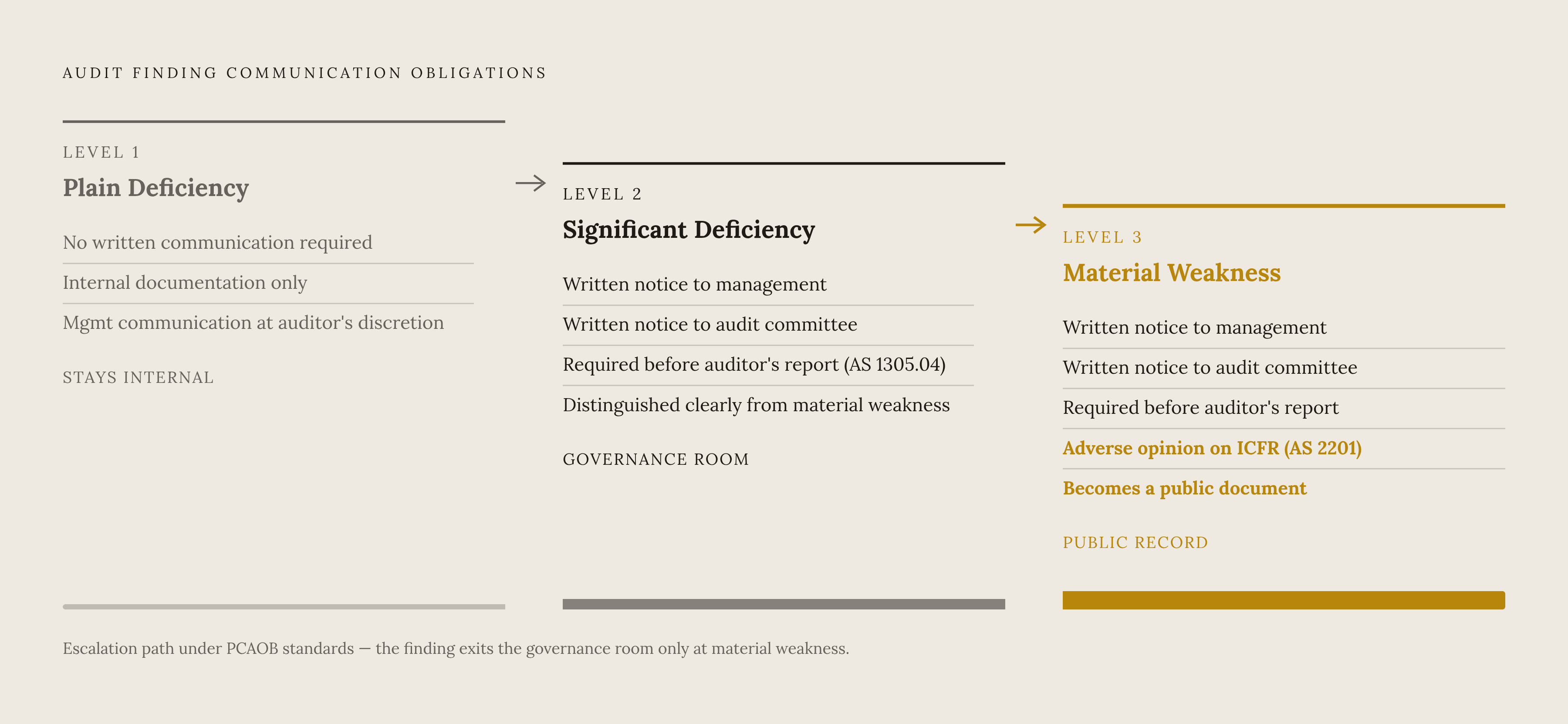
Once a deficiency has been placed in a tier, that placement triggers a specific and mandatory communication requirement, and the tier determines the form, the recipient, and the timing of that communication. A plain deficiency carries no mandatory written communication to the audit committee or to any external party. It gets documented internally, and communication to management happens at the auditor's discretion rather than under a binding rule. The obligation is lowest here because the underlying risk is lowest too.
A significant deficiency changes that picture. AS 1305.04 requires written communication to both management and the audit committee before the auditor's report on the financial statements is issued. The written communication also has to distinguish clearly between matters classified as significant deficiencies and those classified as material weaknesses. AS 1305.04 does not permit an auditor to lump every elevated finding into one undifferentiated bucket labeled "issues." The audit committee receiving that communication needs to know which tier each finding occupies so that its response can be proportionate: a significant deficiency might warrant a remediation timeline discussed at the next scheduled meeting, while a material weakness generally calls for immediate governance attention.
A material weakness carries the same written communication requirement, but adds a further consequence in an integrated audit conducted under AS 2201: an adverse opinion on internal control over financial reporting, which is a public document, and the material weakness itself must be described directly in the auditor's report. That is a meaningful escalation from an internal communication to a document that becomes part of the public record.
The timing requirement deserves particular emphasis because management sometimes treats auditor communications as a wrap-up formality that happens after the real work of the audit is finished. That is a misreading of the standard. Written communication has to precede the issuance of the auditor's report, so the classification itself has to be resolved before the report gets signed. Reclassifying a deficiency after the report has already gone out is not a routine option available to either the auditor or management; it is an exception scenario, not a normal part of the process.
For audits that are financial-statement-only, meaning private companies, governments, and nonprofits operating under AU-C 265 and GAAS rather than the PCAOB's integrated-audit framework, the communication obligations parallel the public-company structure closely. Significant deficiencies and material weaknesses both have to be communicated in writing to those charged with governance, and the GAAS standard applies whenever an auditor expresses or disclaims an opinion on financial statements at all. GAAS requires this communication regardless of whether the auditor ultimately concludes the financial statements themselves are fairly presented. A clean opinion on the financial statements does not discharge the separate obligation to communicate about internal control.
One further consequence connects classification directly to the audit's substantive findings. When an auditor identifies material adjustments during the course of the audit itself, meaning corrections to the client's books that the client's own controls should have caught, the GFOA notes that such material auditor-initiated adjustments typically will require that a significant deficiency or material weakness be reported. The adjustment is itself evidence that a detection control failed somewhere in the organization's own process, and that evidence feeds directly back into the classification the auditor has to make.
What a material weakness triggers beyond the audit room
A material weakness classification does not stop at the audit committee door. It initiates a cascade of consequences that reach into public disclosure, governance accountability, and in some cases executive compensation, and none of those consequences attach to a significant deficiency. That asymmetry between the two upper tiers gives the threshold separating them so much practical weight.
For public companies subject to PCAOB oversight, the adverse opinion on internal control over financial reporting becomes a public document, and the material weakness has to be described in the auditor's report itself. Investors, analysts, and counterparties read that report, and a described material weakness can shape how each of those audiences prices risk into the company. Where clawback policies are in place, now broadly required for listed companies, a material weakness finding tied to a financial restatement can trigger recoupment of incentive compensation already paid to executives. That is a direct, personal financial consequence flowing from a classification decision made inside an audit file.
For government entities, the GFOA frames material weakness communication as a reputational and operational risk that calls for a proactive management strategy, not merely a box-checking compliance response. A government entity does not face an adverse ICFR opinion in the same disclosure regime a public company does, but it faces public scrutiny of its own kind: budget oversight bodies, rating agencies, and constituents all have reason to care whether an entity's financial control environment carries an identified material weakness.
A significant deficiency produces no public auditor opinion, and its written communication travels only to management and the audit committee, leaving those parties discretion over whether and how to disclose it externally. That is precisely why the line between the two upper tiers matters so much in practice: staying just below the material weakness threshold keeps a matter inside the governance conversation, while crossing it moves the matter into the public record.
The IRS example from the GAO's fiscal year 2025 audit illustrates the practical meaning of the tiers in a large institutional context. GAO reported that the IRS maintained, in all material respects, effective internal control over financial reporting, and no material weakness was identified, but the audit also identified a continuing significant deficiency concerning the IRS's unpaid assessments, along with other deficiencies that did not rise even to the significant deficiency level. The IRS received no adverse opinion on internal control, yet the significant deficiency still required written communication and now sits as part of the public audit record. What does that continuity across audit cycles actually signal? It shows that classification is an annual judgment rather than a one-time determination, and a deficiency that persists year over year is itself evidence that remediation efforts have not yet closed the gap.
The IRS audit also points to a driver of new control risk that extends well beyond tax administration. GAO noted that a workforce reduction of approximately 25 percent during fiscal year 2025 contributed to new control deficiencies at the agency. Organizational change of that scale, whether a reduction in force, a merger, or a rapid restructuring, is a direct driver of control risk in any entity, because controls depend on specific people occupying specific roles with specific knowledge, and removing a quarter of the workforce disrupts that dependency regardless of industry.
How these obligations apply in specialized audit contexts
The severity framework itself does not change from sector to sector, but the accounts, the regulatory overlays, and the practical consequences that feed the likelihood and magnitude analysis differ sharply depending on where an audit takes place. A finding that would stay a plain deficiency in one environment can reach material weakness in another simply because the surrounding stakes differ.
HUD Section 232 audits of multifamily and skilled nursing facility financing illustrate this clearly. Missing the 90-day filing window for audited financial statements can trigger HUD compliance flags on its own, independent of whatever severity classification the auditor assigns to any underlying control deficiency. That HUD reporting obligation runs parallel to, and does not substitute for, the auditor's own communication requirements under AS 1305 or AU-C 265. An entity can satisfy one obligation while still failing the other. The FHA's fiscal year 2025 audit identified a significant deficiency in internal control over financial reporting related to FHA's loans receivable, a finding that nonetheless warranted FHA management's direct attention even though it stopped short of material weakness, which shows the middle tier doing exactly the work it is designed to do: flagging a real problem without triggering the full weight of an adverse opinion. The HUD OIG audit found that HUD ORCF did not receive audited financial statements from all borrowers as required and did not ensure all borrowers fully developed action plans to address risks, a systemic operational control failure at the regulator level. That is a control failure at the regulator's own level, not merely at the level of the individual borrower being audited, and the underlying financial statements disclosed borrowers withdrawing funds when properties lacked available surplus cash, properties carrying cash deficiencies, and properties failing to generate enough cash flow to cover current debts.
SOC 1 and SOC 2 examinations. A SOC 1 examination, conducted under SSAE 18 and AT-C 320, evaluates controls at a service organization that are relevant to a user entity's own internal control over financial reporting. A control deficiency in a SOC 1 engagement is consequential not just for the service organization but for every user entity that relies on those controls for its own financial reporting. SSAE 23 becomes effective for engagements beginning on or after December 15, 2025, a reminder that the standards governing these examinations continue to evolve even as the underlying severity logic, likelihood weighed against magnitude, remains the constant thread running through every one of these specialized contexts.
Sources
- GAO Finds New Deficiencies in Audit of IRS Internal Controls | Tax Notes
- Internal Control Deficiencies in Audits
- AS 1305: Communications About Control Deficiencies in an Audit of Financial Statements | PCAOB
- AS 2201: An Audit of Internal Control Over Financial Reporting That Is Integrated with An Audit of Financial Statements | PCAOB
- Page 1 GAO-26-108898 IRS Financial Reporting 441 G St. N.W.
- Audit of the U.S Department of Housing and Urban Development’s Fiscal Years 2025 Financial Statements | Office of Inspector General, Department of Housing and Urban Development