Year-Round Tax Planning Calendar for Closely Held Business Owners
Understand when tax decisions must happen to avoid permanent missed opportunities.

A closely held business owner typically wears three hats inside a single entity: operator, shareholder, and highest-compensated employee. That overlap means a decision that looks simple on its face, how much W-2 salary to draw, triggers at least three separate tax calculations the moment the payroll run executes. The same number that sets an S-corp owner's paycheck also shapes the Section 199A qualified business income deduction (by reducing the QBI base and, for owners above certain income thresholds, setting the basis for the W-2 wage limitation), the §162(l) deduction for self-employed health insurance, and the ceiling on how much the business can contribute to a retirement plan on the owner's behalf.
An employee, by contrast, has essentially one meaningful annual tax decision: how much to withhold from each paycheck. An owner-operator faces closer to a dozen such decisions, and each one lives inside its own calendar window. Some windows measure months, others measure a single date.
These decisions are permanent. An expired S-corp election, a retirement plan that never got adopted, a payroll run that never happened before December 31: none of these can be corrected after the fact. The tax code gives an owner-operator more decisions than an employee ever faces, and it gives fewer chances to make each one.
Why reacting in March or December forecloses options
Planning that begins in March can only describe what already took place. By the time the prior year's return lands on a desk, the tax year behind it is locked, and March planning can only document that record: no election can be filed retroactively, no income can be re-timed, and no retirement plan decision from that window can be revisited.
December planning fares better only because more of the year's data exists by then, and even so, it arrives rushed. Several retirement plan establishment deadlines have already closed before most owners start their year-end review. Entity elections that needed to be filed months earlier have long since expired. Payroll-based decisions that depend on a full calendar quarter of lead time simply are not available in the final weeks of the year.
What exactly gets lost when a quarter passes unused? Skipping a planning quarter does not just push the work later. It permanently removes the specific set of options that existed only inside that window, the same way missing a flight does not just delay a trip but can cancel a connection three cities down the line. That is the logic behind building a calendar around quarters rather than around a single year-end push, and it is the structure the rest of this piece follows.
Decisions to make and act on in Q1
Q1 occupies a unique position on the calendar: it is the only quarter where an owner can look backward at a fully completed prior year and forward at a fully open current year at the same time. That dual visibility makes it the highest-leverage window of the four for structural decisions, the kind that reshape how the business is taxed.
Several fixed dates anchor the quarter. January 15 is the deadline for the fourth-quarter prior-year estimated tax payment for sole proprietors, S-corp shareholders, and partners, though that payment can be skipped entirely if the full prior-year return is filed and the tax paid by the same date. January 31 is when Form W-2 must reach employees and Form 1099-NEC must reach contractors paid at or above the reporting threshold (in 2026, that date falls on a Saturday, pushing the actual deadline to February 2), and the same date governs filing with the relevant federal agencies when filing electronically. March 15 carries perhaps the most consequential date of the quarter: the deadline for filing Form 2553 to elect S-corporation treatment effective for the current tax year. Late elections exist in limited circumstances, but they are not guaranteed, and March 15 remains the only reliable window for this decision.
The deadlines frame the quarter, but the decisions inside it carry the real weight. One is whether to extend the business return. An extension is often the correct call when a K-1 is still outstanding, retirement plan contributions are still being calculated, or the books need cleanup before an accurate return can be filed. An extension buys time to file, not time to pay, so any tax owed still needs to be paid by the original deadline regardless of the extension. A second decision is whether the current entity structure still fits the business. Q1 is the easiest time of year to make this call, because the prior year's results are fresh and the current year has not yet generated enough income to complicate the comparison. A third is retirement plan review: does the plan currently in place still match the business's needs, and if a new plan is warranted, does the paperwork start now, rather than waiting for Q4, when several establishment deadlines compress the available window to almost nothing?
None of this works without clean books. A projection built on records that are weeks or months behind, or on expense coding nobody trusts, produces a number but not an answer. Reconciling prior-year accounts and closing out final reports before the March filing deadline is what gives the mid-year projection in Q2 its value.
Separating safe-harbor payments from real tax liability
Q2 carries two deadlines that fall close together and ask for two entirely different calculations, and conflating them is the single costliest mistake closely held owners make at mid-year. The mistake has a name: treating the safe harbor payment as though it answers the question "what do I owe?" when it only answers "will I owe a penalty?"
Safe harbor is a penalty-avoidance number, nothing more. Paying enough to satisfy it means the IRS will not assess an underpayment penalty, but it says nothing about the actual tax bill waiting in April. These are two separate calculations, and an owner coming off a low-income prior year illustrates the gap clearly: that owner can carry a small safe harbor figure into a current year where income is running substantially higher. Hitting safe harbor in that scenario avoids the penalty. It does nothing to prevent a large balance due the following April, because the safe harbor number was never built from the current year's actual results.
What question should an owner actually be asking in Q2, then? Not "did I hit safe harbor?" but "what will I actually owe, and is enough cash set aside to cover it?" That reframing is the entire substance of Q2 planning.
The deadlines themselves are straightforward. April 15 covers individual returns (Form 1040), C-corporation returns (Form 1120), and sole proprietor returns, and it doubles as the deadline for the first-quarter estimated tax payment and for filing extensions, though extensions move the filing deadline, not the payment deadline. June 15 is the second-quarter estimated payment, covering income earned from April 1 through May 31, only two months of activity despite being labeled the second of four installments.
Q2 is also when the first real comparison between plan and reality becomes available. Q1 actual results give the first concrete data point against the prior-year projection, and if revenue is running materially above or below that plan, estimated payments should be recalculated now, not held until September when less time remains to adjust. Retirement contribution tracking belongs in this same review: is the owner on pace for the full-year contribution target, and does the current payroll schedule actually support reaching it? Finally, once the prior-year return is filed, it is worth reviewing for what it reveals. What could have gone differently, and what does that difference suggest about how the current year's structure should be set?
Why Q3 is the most consequential planning quarter
By Q3, eight months of actual results exist, and that is what makes this the first point in the year where a projection is reliable enough to actually drive decisions. Several of those decisions carry deadlines that fall in or immediately after Q3. This is precisely why this quarter tends to be the most underestimated on the calendar. Owners who treat Q3 as a quiet stretch between spring filings and year-end scramble are the ones who arrive at December with far fewer options than they think.
Form 5500 or Form 5500-EZ for a calendar-year retirement plan is generally due July 31, with an extended deadline into October 15 for plans that filed Form 5558, and missing this underlying structure is easy, because the filing sits outside the usual tax-return calendar, and expensive, because it attaches to the retirement plan itself.
The intellectual core of Q3, though, is owner compensation. For S-corp owners, reasonable compensation is not a static number fixed at the start of the year. It scales with what the business actually produced. A year that nets substantially more than the original projection supports a materially higher W-2, and that W-2 has to be run through payroll before December 31 to count for the year. Why does the timing matter so much here specifically? Because the same payroll run that sets compensation also sets two other figures: the employer contribution limit for a 401(k) or profit-sharing plan, and the §162(l) deduction for self-employed health insurance. Setting compensation in Q3, rather than waiting for December, creates room to run a correcting payroll if the first calculation turns out wrong, something that becomes far harder to execute cleanly in the final two weeks of the year.
September is realistically the earliest point where eight months of closed books can support a confident projection of the remaining four. Running that projection now, instead of waiting until November or December, is what creates the lead time needed to act on whatever the projection reveals. Retirement plan type and funding level decisions belong here too. Finalizing them in Q3 gives plan documents and payroll adjustments enough runway to be completed before the Q4 deadlines arrive and compress everything into a much smaller window. The quality of the Q3 projection, in other words, directly determines how much can actually get executed in Q4. A rushed or late projection in September does not just produce a worse number. It shrinks the set of strategies still available to act on by the time Q4 begins.
What must be executed before December 31
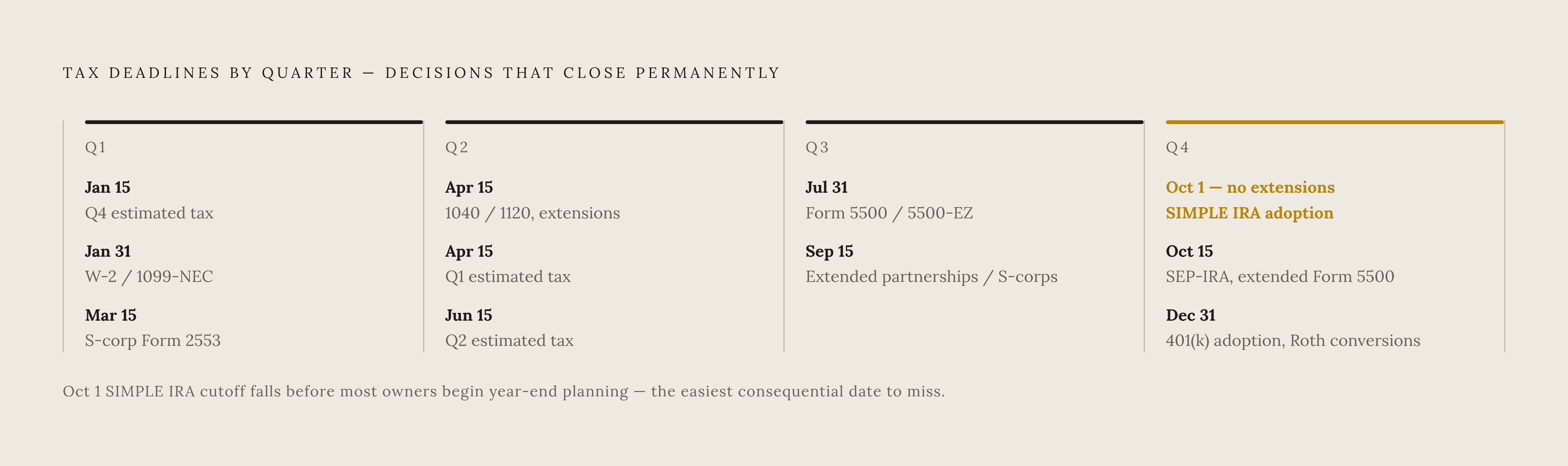
Q4 is the execution quarter for decisions made back in Q3, but it also holds a set of hard cutoffs at midnight on December 31, after which specific elections, contributions, and purchases stop producing any tax benefit for the year regardless of intent. Intent does not extend a deadline. Only timely filing does.
October carries two dates that arrive before most owners start thinking about year-end. October 1 is the last day to adopt a new SIMPLE IRA for the 2026 tax year. No extensions exist for this deadline, and missing it means waiting until 2027 to establish the plan, which makes it one of the easiest deadlines to miss precisely because it falls before the traditional year-end planning season even begins. October 15 is the SEP-IRA contribution deadline for sole proprietors and single-member LLCs that filed a personal return extension, while partnerships and S-corps face an earlier September 15 extended deadline. October 15 also marks the extended Form 5500 and 5500-EZ deadline for plans that filed Form 5558 by July 31.
December 31 itself closes several doors with no extension available. New retirement plan adoption follows different rules depending on plan type: a 401(k) must be adopted by December 31 to permit employee deferrals for 2026, while profit-sharing, defined benefit, and cash balance plans can be adopted as late as the employer's tax-filing deadline, including extensions, under the SECURE Act, though a 401(k)'s employee deferral feature still requires adoption by year-end. A solo 401(k) for a sole proprietor is the one notable exception, since SECURE 2.0 allows adoption as late as the April 15, 2027 filing deadline. Solo 401(k) employee elective deferrals for entities other than sole proprietors, by contrast, must be made by December 31 with no such flexibility.
Roth conversions follow the same hard stop: traditional IRA or 401(k) funds converted to Roth must complete the conversion within 2026 to count for that tax year, a decision that carries particular weight for an owner sitting in a lower-income year or anticipating a future income spike that would make the same conversion far more expensive later. Pass-through entity tax elections add a layer of complexity because they run on state timelines. New York sets its PTET election deadline as early as March 15, others tie the deadline to the entity's return due date (typically April 15), and California sets a mid-year deadline of June 15. The election lets the business deduct state income taxes at the entity level, working around the individual SALT cap under OBBBA, and missing the state-specific date forfeits that benefit for the entire year with no way to recover it later.
What ties Q4 back to everything earlier in the calendar is simple: almost none of these deadlines can be met cleanly by an owner who starts paying attention only when they arrive. The SIMPLE IRA cutoff on October 1 depends on decisions made in Q3. The December 31 compensation run depends on a projection built in September. The PTET election depends on a state deadline that, in some states, has already passed by the time most owners start thinking about year-end. The calendar only works as a sequence, and each quarter either opens the next one's options or quietly closes them.