Section 199A Qualified Business Income Deduction Planning for Pass-Through Entities
Permanence enables strategic planning, but the deduction still requires careful structuring.

Section 199A qualified business income deduction planning for pass-through entities now has a longer horizon. Permanence makes deliberate, multi-year planning possible, but it does not make the deduction automatic. Its value still turns on the owner’s taxable income, the business’s classification, and the wages and property that support the deduction. Those variables call for coordinated decisions before filing season.
Why Section 199A planning changed permanently in July 2025
The One Big Beautiful Bill Act, or OBBBA, signed July 4, 2025, eliminated Section 199A’s December 31, 2025 sunset. Before that amendment, the deduction was a temporary TCJA provision, limiting the horizon for planning. The OBBBA amended §199A(i), replacing the expiration paragraph with a minimum deduction provision. The deduction remains at 20%. The higher figure discussed during House deliberations did not become law.
The deduction is claimed on the owner’s individual return, using Form 8995 or 8995-A. Each partner or S-corporation shareholder applies the rules to their allocable share of income, deduction, and loss, subject to the owner-level taxable income limit.
How the deduction's three income regimes determine who has a planning problem
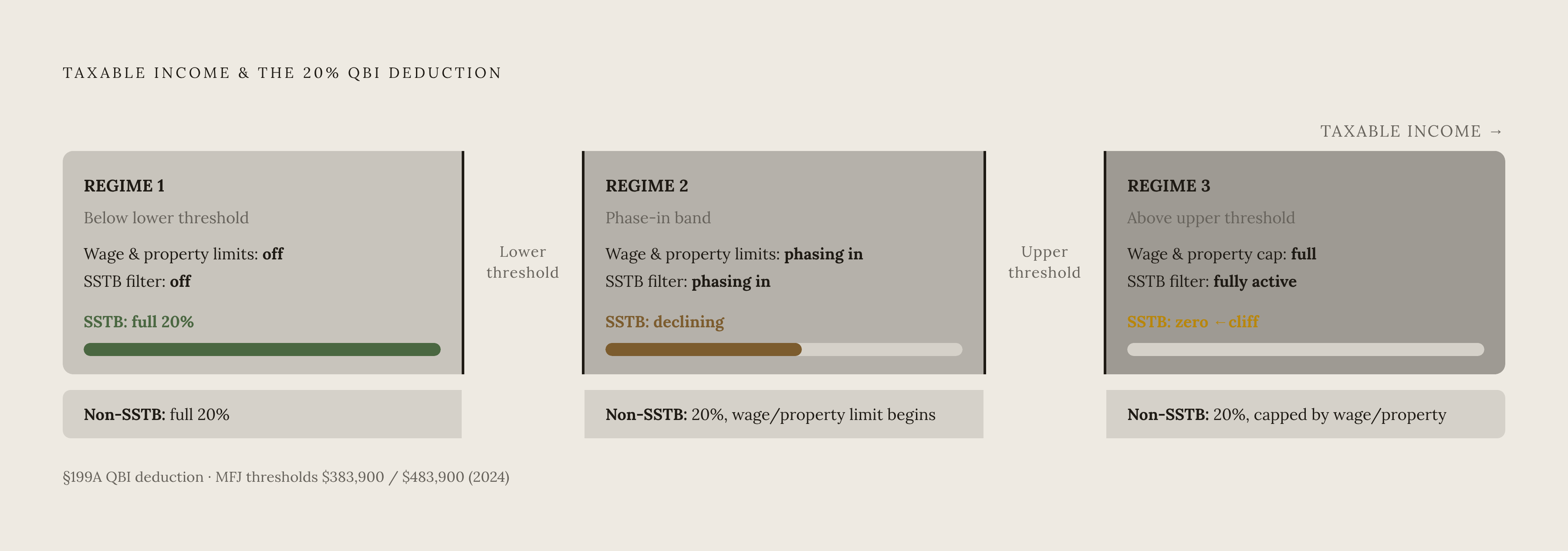
The initial diagnosis compares the owner’s taxable income with the applicable threshold. For 2026, that comparison depends on filing status, including single, head of household, and married filing jointly. Below the threshold, in Regime 1, the W-2 wage limitation, property-basis limitation, and specified service trade or business filter do not apply. A physician can receive the same full 20% deduction as a manufacturer, subject to the general deduction rules. Owners in this zone use the shorter Form 8995.
Regime 2 is the phase-in band between the base threshold and the upper limit. Here, wage and property limits begin to apply, while owners of specified service trades or businesses, or SSTBs, see their eligible deduction move toward zero. The OBBBA widened this band, allowing more owners a partial deduction. Above its upper limit, in Regime 3, the wage and property cap applies fully to non-SSTBs, while the SSTB business deduction disappears. The new statutory minimum may provide a floor for eligible owners, but it is not a substitute for planning.
QBI includes Schedule C net profit, qualifying pass-through profit on a K-1, and net rental income that rises to the level of a trade or business. Qualified REIT dividends and qualified PTP income enter a separate component. Capital gains, C-corporation dividends, and interest unrelated to the business are excluded. Reasonable W-2 compensation paid to S-corporation owner-employees is also excluded, a distinction that becomes central to salary planning.
Why SSTB classification is the deduction's sharpest edge
For an SSTB owner above the upper threshold, the business’s classification eliminates the QBI deduction. A physician operating through a pass-through entity illustrates the consequence. Once taxable income exceeds the fully phased-in threshold, the deduction on that service-business income is zero. Skilled nursing entities, nurse practitioners, and physical therapy groups face the same health-field exposure. The loss concerns the deduction on all the business income, including income below the boundary.
Section 199A’s SSTB fields include health, law, accounting, actuarial science, performing arts, consulting, athletics, financial services, brokerage services, and investing/trading businesses. The definition also covers businesses whose principal asset is the reputation or skill of their owners or employees. A consulting business that works with technology therefore needs more than a technology label to settle its classification. The activity and revenue mix matter.
Treas. Reg. §1.199A-5(c)(1) makes that revenue mix consequential through its de minimis rule. If SSTB receipts exceed the permitted share, the whole business can be classified as an SSTB, with a tighter threshold for businesses above the gross-receipts ceiling. By contrast, the statute explicitly excludes engineering and architectural services from the SSTB list. Their owners face wage and property limits at higher incomes. Correctly classified real estate, mortgage banking, manufacturing, retail, and technology businesses also remain outside the SSTB category, subject to their revenue mix.
How W-2 wages and property basis determine the deduction for non-SSTB owners above the threshold
Clearing the SSTB test does not guarantee a deduction equal to 20% of profit. Above the income threshold, payroll and qualified property determine how much of that potential deduction survives. The limitation uses the greater of a wage-only test and a second test combining a smaller share of W-2 wages with a percentage of property basis. That basis is the unadjusted basis immediately after acquisition, or UBIA. The business needs enough wages or property to support its QBI.
A sole proprietor or single-member LLC with no employees and no depreciable property has neither source of support. In Regime 3, that leaves no wages or UBIA to use in the ordinary calculation, so only the statutory minimum may be left where it is available. Qualified property must be tangible, depreciable property held and available for business use at year-end. It must also have been used during the year to produce QBI, and its depreciable period must not have ended before year-end.
This is why real estate and multifamily housing businesses with a large investment in property can support a deduction with a fairly small payroll. Their property base contributes through the second test. Businesses that use a professional employer organization must check whether those wages count as their W-2 wages for this purpose. For S-corporation owners, the calculation has a further tension. Owner wages reduce QBI but increase wage-limit support, creating a mathematical sweet spot rather than a simple preference for higher or lower pay.
Entity structure and compensation decisions as the primary planning levers
When an S-corporation owner’s salary goes up, less pass-through profit is left that can qualify for the deduction. Yet paying too little can leave the wage limitation below the deduction that the remaining profit would otherwise support. The useful comparison is therefore the deduction lost through lower QBI against the deduction supported by additional wages.
Reasonable compensation remains a separate constraint on that calculation. Pay must be reasonable for the work done, even when a different amount would give a better tax result. Within that constraint, salary needs annual recalculation as profits, owner income, and indexed thresholds change. For a high-profit sole proprietorship or single-member LLC without employees or property, an S-corporation election and payroll structure can change the deduction mechanics. A non-SSTB with a lot of property may have less need to fine-tune wages because its UBIA already helps support the deduction.
Multi-entity owners have another lever through aggregation, which can combine one business’s wages or UBIA with another’s QBI. Eligibility requires majority ownership by the same person or group, a shared majority of the tax year, and no SSTBs in the group. The businesses must also meet at least two operational factors involving related offerings, shared facilities or significant centralized functions, and coordinated or interdependent operations. Aggregation requires careful documentation and consistent reporting once elected. It cannot convert SSTB income into eligible non-SSTB income.
These federal choices also need a state-level comparison. California, New Jersey, and Pennsylvania do not provide the Section 199A deduction, so federal savings do not describe the combined result. Owners in non-conforming states should model the net combined effective rate before restructuring for Section 199A. Permanence lengthens the consequences of entity selection, while later restructuring carries tax and legal costs.
Income-level strategies for SSTB owners who face the deduction cliff
For SSTB owners, the main lever is taxable income. Below the threshold, SSTB status is irrelevant to deduction eligibility. Managing income therefore aims to keep the owner below the threshold that applies or within the phase-in band. A deduction-producing decision must be evaluated for both its ability to move the owner into a more favorable regime and its other effects.
Retirement contributions offer one route. SEP-IRA, defined benefit plan, and 401(k) contributions can lower adjusted gross income and taxable income, which can let the owner qualify again for part or all of the deduction. Defined benefit plans allow the largest contributions and can be particularly effective for high-earning sole practitioners and small partnerships with predictable income. Deductible contributions can also reduce QBI, so the comparison must include both effects. In many scenarios, restored eligibility outweighs that reduction.
Where it is available, owners can also elect a pass-through entity tax, or PTET. The entity pays state income tax and receives a federal business deduction, reducing the owner’s federal taxable income. For an SSTB owner near a boundary, that reduction may restore deduction eligibility. However, the result depends on the state, the owner’s circumstances, and interaction with the SALT deduction cap. The PTET and Section 199A calculations therefore belong in the same model.
Qualified REIT dividends provide a supplement through their separate Section 199A component, which can preserve a 20% deduction on that income even when the SSTB’s QBI component is fully phased out. It does not replace the lost business deduction dollar-for-dollar. Owners near the upper boundary still need to project their income each quarter because a large fee or gain can push it past the range where any deduction remains.
Real estate and rental income: when the deduction applies and when it doesn't
Direct rental income qualifies only when the activity rises to the level of a trade or business. Triple-net landlords should not assume that owning income-producing property satisfies that requirement. Triple-net leases generally fall outside the rental safe harbor because the lessee does most of the work of managing the property. When a rental falls outside the safe harbor, whether its receipts are QBI still depends on whether it qualifies as a trade or business.
IRS Revenue Procedure 2019-38 has a safe harbor for rentals that have separate books and records and qualifying rental services. It calls for 250 or more hours of rental services per year, with a three-of-five-year rule for enterprises in existence at least four years. The owner, employees, agents, or independent contractors can do that work. The parts of mixed-use buildings, including commercial triple-net space and actively managed residential units, must each be checked on their own.
Once a rental enterprise qualifies, substantial UBIA can support the deduction above the income threshold even where payroll is modest. That property advantage does not remove the need to establish qualifying business income first. Qualified REIT dividends and qualified PTP income follow the separate Section 199A component instead. For investors holding REITs rather than direct property, that creates a different qualification path without the direct rental trade-or-business analysis.
Why multi-year planning — not filing-season review — is now the right frame for 199A
The planning calendar follows from these mechanics. Entity structure, payroll, retirement funding, PTET elections, and aggregation cannot all be resolved after the year closes. Defined benefit planning needs actuarial work months before year-end, and even though SEP contributions are more flexible, owners must plan to have the cash for them. PTET deadlines differ, with some states requiring an election during the tax year and others allowing it by the entity’s return deadline, including extensions.
Permanence also does not mean a static calculation. IRS Rev. Proc. 2025-32 provides for inflation-indexed thresholds, while business income can change independently of them. Owners near a boundary should model at least a three-year forward projection and recalibrate annually. Bonus depreciation, also made permanent by the OBBBA, illustrates why those models must connect decisions. Accelerated depreciation can reduce both taxable income and QBI, making its net Section 199A effect depend on the owner’s regime.
A specialized CPA advisory relationship provides a practical setting for quarterly projections and coordinated salary, retirement, and PTET decisions. Changes in ownership or business structure also call for renewed aggregation analysis. Where a firm provides both financial statement assurance and tax advisory, coordination can identify QBI classification problems in income reporting before they become filing errors. The purpose is to align decisions whose combined consequences determine how much of a permanent deduction the owner can actually use.