Materiality Thresholds in Financial Statement Audits
Auditors determine materiality through structured judgment, not fixed percentages or formulas.

Materiality in an audit is the threshold at which a financial statement error becomes significant enough to change the decision of a reasonable investor or creditor, not a percentage pulled from a table, and reaching that threshold requires a structured chain of judgments rather than a single calculation.
What materiality actually means in an audit, and what it does not mean
The AICPA's current definition holds that misstatements, including omissions, count as material if there is a substantial likelihood that, alone or combined with other errors, they would influence the judgment a reasonable user forms from the financial statements. That wording was deliberately realigned in 2019 to match U.S. GAAP and the definitions already used by the U.S. judicial system, the PCAOB, and the SEC. Before that realignment, AICPA auditing standards had drifted out of step with judicial and regulatory usage, and the 2019 change restored the original definition that had governed from 1980 to 2010. The fix was not cosmetic: when an auditing standard and the courts define the same word differently, an audit opinion built on one definition can be second-guessed under the other.
The PCAOB's AS 2105 carries the same user-centered logic, and its lineage runs back further than most practitioners realize. The standard traces to the Supreme Court's 1976 decision in TSC Industries, Inc. v. Northway, Inc., which held that a fact is material if there is "a substantial likelihood that a reasonable shareholder would consider it important." The Court went further and clarified something that often gets lost in paraphrase: materiality does not require proof that the fact would have changed the investor's final decision, only that it "would have assumed actual significance" in the investor's thinking. That is a lower bar than "would have flipped the outcome," shaping how conservatively auditors treat borderline items.
One complication rarely makes it into casual summaries of the topic. The U.S. definition and the IFRS definition still diverge. The IASB frames materiality as misstatements that could "reasonably be expected to influence the decisions that the primary users of general purpose financial statements make on the basis of those financial statements." The language looks similar to the U.S. standard at first glance, but the phrasing differs enough to matter for any company reporting under both frameworks, where auditors have to track two legal definitions of the same core concept rather than one.
What none of these definitions supply is a number. None of them say a specific percentage, or a specific dollar amount, or any other fixed figure. That omission reflects the fact that materiality depends on the specific entity, the specific users of its financial statements, and the specific decisions those users are making, and no single rule could capture that variation without becoming wrong in most applications. The vagueness in the legal definition is what forces the rest of the framework to exist: overall materiality, performance materiality, and the clearly trivial threshold are the profession's answer to the question the definition deliberately leaves open.
The materiality threshold
Here is the tension that defines the entire structure that follows: the profession explicitly prohibits treating any single percentage as a safe harbor, and yet percentage-based benchmarks remain the starting point every auditor actually uses. Both things are true at once, and reconciling them is the real work of planning an audit.
The AICPA instructs auditors to apply professional judgment calibrated to the entity's size, its industry, the strength of its internal controls, and its financial performance. No prescribed threshold applies uniformly across entities, because a dollar figure that is immaterial for a multinational manufacturer could sink a small nonprofit. But what if two companies have identical revenue and near-identical misstatements? Even then, dollar size alone does not settle the question. A misstatement that is tiny in dollar terms can still be material: a related-party transaction, a loan covenant violation, or an error that trips a regulatory compliance threshold can all matter regardless of how small the number looks on the page.
Location inside the financial statements changes the weight of a dollar, too. An error buried in reported earnings tends to matter more than the same dollar amount sitting in a miscellaneous expense line, simply because earnings are the figure most investors look at first and most closely. That is the qualitative dimension no percentage-based formula can capture on its own, and it is why the auditor has to think like the financial statement user rather than like the bookkeeper who made the entry. The percentage benchmark is a tool for getting a defensible starting number. It is not, by itself, the final word on what the audit should catch.
Choosing the benchmark: the judgment that anchors every number that follows
Before any dollar threshold exists, the auditor has to decide what that threshold should be a percentage of, and that choice carries more weight than it might first appear. The benchmark selected early in planning sets both the scale of every number that follows and the risk posture of the whole engagement.
For an entity with stable profits, auditors typically turn to pre-tax income, the figure investors watch most closely, applying a percentage commonly between 5% and 10%, with 5% the most typical figure in practice. The exact percentage moves within that range depending on the entity's risk profile, whether its stock trades publicly, and how closely analysts track its earnings against expectations. A privately held, steadily profitable business and a publicly listed company bound by tight loan covenants might operate in the same industry and still land on different benchmarks and different percentages within that benchmark. That difference reflects the fact that the two companies have different users relying on different numbers for different decisions, and the benchmark is supposed to track the user's focus, not the auditor's convenience.
Pre-tax income works poorly as a benchmark for cash-burning startups, for entities with earnings that swing year to year, and for nonprofits not organized around profit. In those cases, auditors turn to alternatives: total revenue, common for service businesses, or total assets, common for capital-intensive industries, financial institutions, and investment funds. Because revenue and total assets are typically much larger numbers than pre-tax income, auditors apply lower percentages against them to arrive at a comparable dollar threshold. Whatever benchmark gets chosen, it has to satisfy two conditions at once: it has to be relevant to how financial statement users actually make decisions, and it has to be stable enough period to period that the threshold built on it does not swing wildly for reasons unrelated to the business's real condition.
When pre-tax income is volatile because of a one-time event, a litigation settlement or an asset sale, auditors normalize the figure by averaging income across several recent periods. That average is meant to reflect the entity's sustainable earning power rather than the distortion of a single anomalous year. One more link closes the loop here: the benchmark choice and the auditor's risk assessment are not independent decisions. Higher inherent risk pushes the chosen percentage toward the low end of its range, which produces a smaller dollar threshold and, in turn, demands more extensive testing. Choosing the benchmark and assessing risk happen together, each one informing the other.
Overall materiality: translating the benchmark judgment into a working dollar figure
Once the benchmark and the percentage are set, the arithmetic produces overall materiality: the maximum amount of aggregate misstatement the financial statements can carry before a reasonable user would call them misleading. That single dollar figure then governs how much work the rest of the audit requires.
Two failure modes sit on either side of this number, and both are real operational problems rather than theoretical ones. Setting overall materiality too high lets genuinely serious errors pass through undetected, because the audit never looked closely enough to find them. Setting it too low balloons the audit in cost and effort without meaningfully improving the reliability of the opinion at the end. Neither failure is abstract. Each one raises the hours billed and the risk carried by the firm signing the report.
Overall materiality shapes the nature, timing, and extent of every procedure that follows it. Accounts the auditor judges high-risk get detailed transaction testing. Lower-risk accounts might be addressed through analytical review instead of transaction-level checks, and sample sizes in the high-risk areas run larger specifically to raise the odds of catching an error that matters. Overall materiality gets set at the very start of the engagement, during planning, but it is not fixed once chosen. If circumstances shift materially during fieldwork, the auditor has to revisit the figure rather than carry an outdated number through to the opinion. That revisit requirement matters because it is the structural link to the next layer. Overall materiality, taken by itself, says nothing about how individual accounts should be tested. That job belongs to performance materiality.
Performance materiality: the working buffer that makes overall materiality meaningful
A single error below overall materiality is not the only way an audit can miss something significant. Several smaller errors, none individually alarming, can accumulate across different accounts until their sum crosses the overall materiality line, even though no single misstatement ever looked big enough on its own to raise concern. That accumulation risk is the exact problem performance materiality exists to manage.
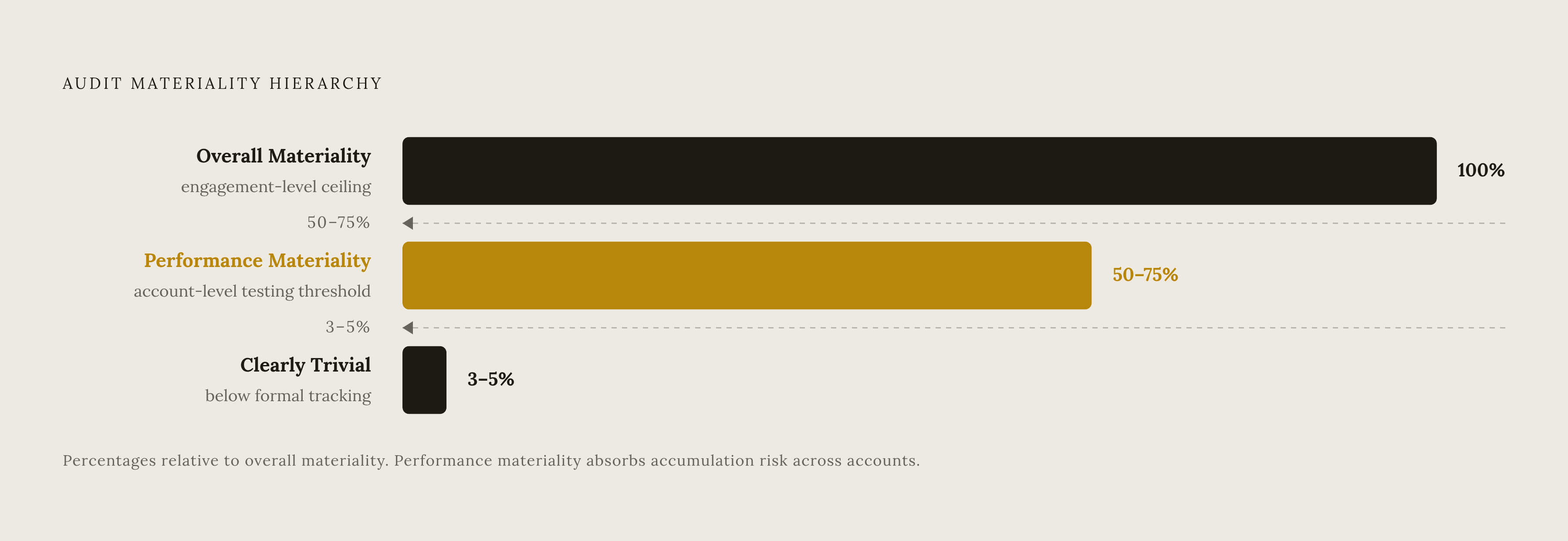
AS 2105 requires performance materiality to be set low enough to reduce the probability that the sum of all uncorrected and undetected misstatements exceeds overall materiality. In practice, auditors commonly set performance materiality somewhere between roughly half and three-quarters of overall materiality, and the exact proportion within that range depends on how likely the auditor judges it that multiple smaller errors exist scattered across the financial statements. A business with weak internal controls and a history of small recurring errors pushes the auditor toward the lower end of that range. A business with a clean track record and strong controls can sit closer to the upper end.
Performance materiality operates as a control at the account level. It is the threshold applied to individual balances and classes of transactions, inventory, accounts receivable, payroll, rather than to the financial statements taken as a whole. Together with overall materiality at the top and the clearly trivial threshold still to come at the bottom, performance materiality forms the middle rung of a three-layer ladder that guides testing, evidence-gathering, and the evaluation of misstatements across the entire engagement. If auditors tested every account right up to the overall materiality limit, undetected errors accumulating quietly across several accounts could push the aggregate past that limit before anyone noticed. Performance materiality tightens the working target below the real ceiling specifically to leave room for that accumulation without breaching it.
The clearly trivial threshold: where audit efficiency and professional judgment meet
Below performance materiality sits a third line, the clearly trivial threshold, and it exists to answer a narrower but practical question: at what point does an error become so small that formally tracking it adds cost without adding reliability?
The clearly trivial threshold functions something like a cutoff for the audit's running schedule of identified differences. Misstatements below that line get noted but are not accumulated or formally assessed for correction the way larger items are. The rationale is efficiency rather than carelessness: not every minor variance in a ledger deserves the same documentation effort as a transaction nearing performance materiality, and setting the cutoff gives the audit team a consistent, defensible rule rather than a judgment call repeated line by line. The threshold sits well below performance materiality by design. It is meant to capture only the items that are inconsequential on their own and that could not, even added together with other similarly small items, approach anything near material.
Group audits complicate this picture somewhat, since each component of a group is assigned its own materiality figure, which must come in lower than the overall group materiality, and the component-level performance materiality and clearly trivial thresholds have to stay consistent with that group-wide structure. Multi-entity audits add this layer of complexity, which this discussion will not unpack in full.
Applying the Threshold Structure Throughout an Engagement
Setting these three thresholds during planning is only the beginning of their role. Materiality operates as a live decision-making tool at every later stage of the engagement: shaping risk assessment, directing sample sizes during fieldwork, and ultimately governing how the auditor evaluates misstatements before forming an opinion.
During planning, materiality tells the audit team where to put its attention. Accounts carrying a high risk of material misstatement receive more extensive procedures, while low-risk accounts can often be addressed through analytical review rather than detailed testing. Sample size follows the same logic directly: in high-risk areas, where a material misstatement is more likely to be hiding, auditors draw larger samples, and in low-risk areas, smaller samples are enough to support a conclusion. The materiality threshold is what makes that calibration explicit and defensible rather than arbitrary.
The structure's real payoff appears at the end of the engagement, when identified misstatements get weighed against the thresholds set months earlier. If management declines to correct a misstatement the auditor considers material, the auditor can issue a qualified or adverse opinion rather than an unqualified one. That is the mechanism connecting what gets found in fieldwork to what gets written in the final report, and it is the reason materiality cannot be treated as a number written down once during planning and then forgotten. Materiality also is not frozen once fieldwork begins. A significant acquisition, a restatement discovered in a prior period, or a control environment that deteriorates mid-engagement can all force the auditor to reset overall materiality before the opinion is finalized. One might argue that revisiting the threshold mid-audit introduces inconsistency into the process. It is closer to the opposite: refusing to revisit it when circumstances genuinely change is what would make the final opinion unreliable.
Where the quantitative framework breaks down: qualitative materiality
Everything described so far, the benchmark, overall materiality, performance materiality, the clearly trivial threshold, is a quantitative scaffold built to make an inherently judgment-based standard operational. But the legal and regulatory definition of materiality was never purely quantitative to begin with, and the framework has to bend to that fact rather than override it.
A misstatement can fall well below every dollar threshold the audit has calculated and still be material, because its nature rather than its size is what a reasonable user would care about. The TSC Industries standard asks whether a fact would have assumed actual significance in a reasonable shareholder's thinking, and dollar size is only one input into that question. A small misstatement tied to executive compensation, a covenant violation, illegal activity, or a related-party transaction can trigger exactly the kind of attention a strictly quantitative threshold would never flag. That raises an important question for anyone inclined to treat the percentage-based framework as the whole story: if qualitative factors can override the math at any point, what was the quantitative structure actually for?
The quantitative scaffold gives the audit a disciplined, consistent, and defensible starting point, the place where testing begins and where resources get allocated with some rigor. Qualitative judgment is what the auditor applies on top of that scaffold, not instead of it, to catch the cases where size and significance pull apart, and this is the feature that keeps materiality tethered to its actual legal purpose, protecting the judgment of the reasonable financial statement user rather than the arithmetic of a benchmark calculation.
Sources
- What Is Materiality in Auditing: Definition and Thresholds - LegalClarity
- ICAEW INTERNATIONAL ACCOUNTING, AUDITING AND ETHICS AUDIT AND ASSURANCE FACULTY
- Materiality: Setting Thresholds and Using Them
- AU 312A Audit Risk and Materiality in Conducting an Audit
- SEC Staff Accounting Bulletin No. 99: Materiality
- 1