Medicaid Cost Report Settlement Accounting in Long-Term Care
Settlement timing and accrual accounting create financial statement risks for nursing homes.

The path from filed report to realized revenue
A nursing facility's Medicaid revenue is not fixed by the rate sheet posted at the start of the year. It moves, sometimes by millions of dollars, based on how the cost report filed months earlier gets settled by the state agency reviewing it. Settlement runs through several stages, each with its own paperwork and its own risk, and the accounting decisions made at each stage decide whether the facility's financial statements reflect what it actually earned or something close to an educated guess.
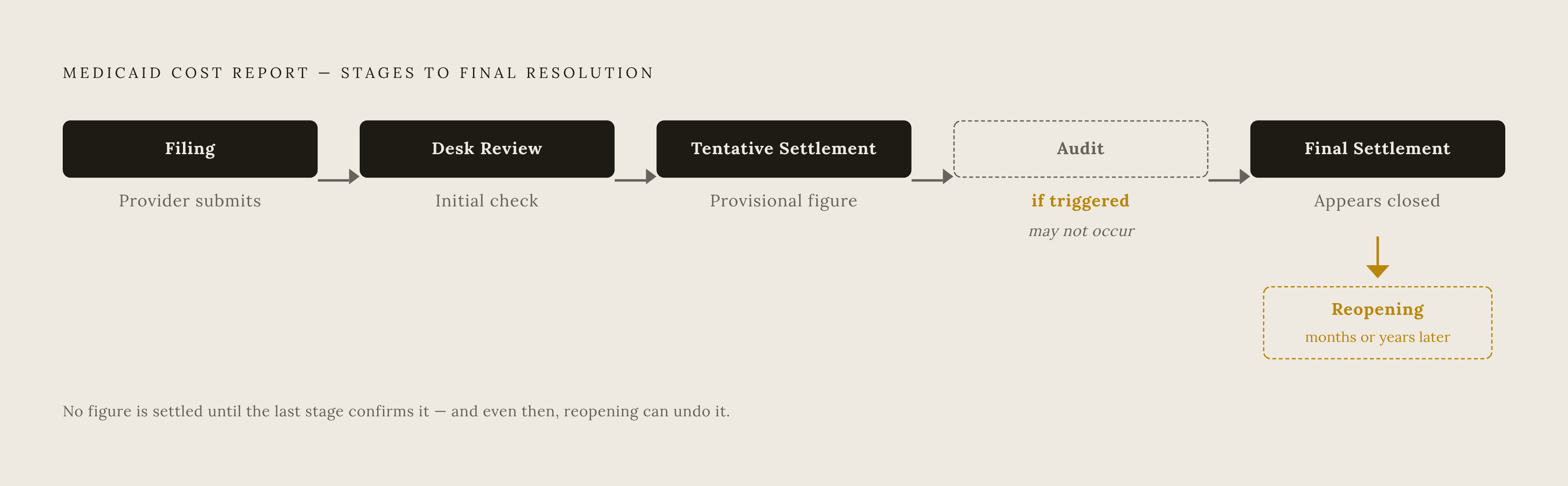
The sequence goes filing, then desk review, then tentative settlement, then audit (which may or may not happen, depending on the state and the year), then final settlement, and sometimes a reopening months or years after everyone assumed the matter was closed. Medicare cost reports run through Medicare Administrative Contractors, private entities under contract with CMS that process the report, determine total reimbursement, and decide, at their own discretion, whether a desk review is enough or a field audit is warranted. Medicaid works differently because every state runs its own machinery. Michigan handles this through a division split between a Reimbursement and Rate Setting Section and a separate Audit Division. Mississippi routes cost reports through its Division of Medicaid using a third-party portal, the MSLC Portal, rather than an in-house system. The names differ state to state, but the obligation does not: under 42 CFR §447.253(f) and (g), every state Medicaid agency has to require uniform cost reports and audit providers' financial and statistical records on some periodic basis. That requirement is a condition of the state's own Medicaid plan, full stop.
What does periodic audit actually mean for an administrator staring at a filed cost report? It means the number on the page is provisional until the state says otherwise, sometimes for years. A tentative settlement figure can sit on the books through two or three fiscal year-ends before an audit locks it down, and until that happens, everything downstream of it (the rate, the receivable, the year-end accrual) is a placeholder wearing the clothes of a fact. Treating that placeholder as settled fact is the single most common error in this whole process, and it is an avoidable one.
How state agencies translate cost report data into Medicaid payment rates
The cost report is not paperwork filed for its own sake. States use it directly to build the rates that pay for care the following year, so an error buried in a nursing cost center or a therapy allocation does not just misstate the past. It distorts the future.
South Carolina's methodology shows the mechanics. Rates get set using the most recent cost report data on file, and cost center standards get built off that same data. General services and the laundry, housekeeping, and maintenance cost centers get benchmarked at 105% of the mean among reporting facilities, with a 1.7% inflation factor layered on top. Facilities are assumed to hit a 90% minimum occupancy factor when the state calculates individual reimbursement rates, and the skilled percentage used in that calculation comes from state fiscal year 2026 Medicaid paid days.
North Carolina bakes cost limitations straight into its rate framework rather than treating them as a side check, and this is where the real discipline shows: caps mean something only if they get enforced against the actual contract, not just checked on paper. Director's fees are capped at $2,400 annually, or $200 per meeting. Owner or administrator salaries are capped on a sliding scale by bed count, running from $57,097 for a facility with 1 to 50 beds up to $89,724 for one with 200 to 249 beds. A facility that pays its administrator above that ceiling does not get to fold the excess into its allowable cost base, no matter what the employment contract says. That is the part administrators tend to miss: the contract governs the payroll, but it does not govern what Medicaid will reimburse.
Mississippi revised its methodology on December 5, 2025 to fold Medicaid-only therapy costs into the calculation for cost reporting periods ending on or after that date. Looking across all three states, the cost report is not a compliance exercise that happens to also inform rates. It is the rate-setting mechanism itself, run once a year, with real dollar consequences for the state's Medicaid budget and for every facility's bottom line.
The accrual accounting problem that settlement timing creates
Settlement timing does not respect the fiscal year-end, and accrual-basis financial statements demand that revenue be recognized in the period it relates to, regardless of the period the check happens to arrive.
Retroactive Medicaid payments are the clearest version of this mismatch. A state might issue a lump-sum payment in March that relates to services rendered the prior October through December, and the facility's auditors have to work out how much of that lump sum belongs on last year's income statement versus this year's. Get it wrong and the facility either overstates current-period revenue or leaves prior-period revenue unrecognized, understating what it actually earned when it earned it. Deferred revenue from earlier periods carries the same burden: it has to be tracked and released in the right period, and auditors routinely push facilities to confirm that every adjustment tied to a settlement has actually made its way onto the books before year-end close gets finalized.
Commentary on the 2025 year-end cycle in New York illustrates how many moving parts converge at once, with multiple adjustment streams, active audits, statutory obligations, and pending disputes all landing on the same financial statement in the same period. None of those items sits in isolation. A facility closing its books in that environment is solving five or six problems at once, and each one touches the same settlement receivable or payable line. Treating any one of them as an isolated accrual causes the rest to quietly drift out of alignment with it.
How the cost report form itself is changing for preparers
The mechanics of filing are changing too, and not cosmetically. For reporting periods ending on or after September 30, 2025, skilled nursing facilities move onto the CMS-2540-24 form, replacing the version preparers have used for years.
The new form asks for more, and the additions track exactly where the old form was thin. Payer reporting expands, with far more granular detail on Medicare Advantage utilization and Medicaid managed-care utilization, categories that have grown large enough in most states' patient mix that the prior form's treatment of them looked outdated by comparison. Every cost center gets new columns for contract labor, tracked separately from agency labor, an acknowledgment that staffing costs in long-term care no longer come from one simple payroll line, especially after the staffing disruptions of recent years pushed facilities toward outside agencies. Facility characteristics get clearer, more structured fields of their own. Filing has to happen electronically through the Medicare Cost Report e-Filing portal, MCReF. There is no paper alternative built into the new process.
States are layering their own supplemental instructions on top of the federal change, and that stacking is the part preparers underestimate. North Carolina providers with a fiscal year-end on or after September 30, 2025 need SNF 2025 Instructions Version 6.04 paired with the NC NF Supplemental Cost Report for FY2025, itself split into Version 6.04 for hospital-based providers and Version 6.02 for freestanding ones. Hospital-based nursing facility cost reports in North Carolina are due no later than five months, or 150 days, after fiscal year-end, or concurrent with the Medicare cost report, and the state does not grant extensions except for something like a fire or a flood. A preparer working across multiple states in 2025 and 2026 is managing two transitions at once: a new federal form, and a fresh round of state-specific supplements sitting on top of it.
Related-party cost reporting: the settlement's highest-risk line items
If one line item deserves the most scrutiny before it ever reaches a state reviewer, it is related-party transactions, and the rule most facilities get wrong is not obscure or technical. Federal rule draws a hard line: costs for services, facilities, or supplies purchased from a related organization can only be included in allowable costs at the lower of that organization's actual cost or the market price for comparable services elsewhere. Profit earned on a related-party transaction is not an allowable cost, full stop, no matter what the invoice says the price was.
The exposure across the industry is not small, and treating related-party review as a formality is the actual mistake, not a defensible shortcut. MedPAC has found that more than three-quarters of nursing facilities nationally report payments to related parties, and the lack of transparency in those arrangements makes it genuinely hard for anyone, regulator or analyst, to get a clean read on a facility's real financial condition. For Medicare cost reporting periods ending during fiscal years 2015 through 2020, SNFs nationally reported $160.4 billion in total Medicare payments against $65.4 billion paid out to related parties. That ratio says related-party dealing sits close to the center of this sector's economics, not at its fringe.
An OIG audit sampling 14 facilities found that seven of them, exactly half, failed to properly adjust related-party costs down to the Medicare-allowable basis, producing $1,703,734 in overstated costs across that sample alone. Half the sample got it wrong on a rule that has existed for decades and reads clearly on the page. CMS's own contractors, the MACs, do not, as a matter of policy, review related-party disclosures or the underlying costs as part of routine desk reviews or audits, and that is the structural gap driving the failure rate. The rule exists. The routine enforcement mechanism most facilities assume is checking it, largely is not there. The burden of catching the error sits entirely with the facility's own preparers.
The effect of audit activity and OMIG-style scrutiny on the settlement accrual
State audit infrastructure is staffed, funded, and active, and it shapes directly how confidently a facility can book a settlement accrual.
Michigan handles Medicaid cost report review through a division split between reimbursement and rate-setting functions and a separate audit function, with financial settlement following once the audit closes. Quality assurance supplement payments and quality measurement initiatives fall inside that same scope, so an audit finding in one area can ripple into adjustments the facility never connected to the cost report. Delaware's Auditor of Accounts has run examinations covering 14 long-term care facilities' fiscal records tied to their Statements of Reimbursement Costs under Title XIX, a reminder that state-level financial oversight of these reports runs well beyond the Medicaid agency itself.
State audit activity of the kind New York's OMIG conducts has included reviews focused specifically on dropped services: cases where a facility kept billing for a service after it had actually stopped providing it. That last category builds a liability that sits quietly on the books, and an audit makes it retroactive and usually bigger than anyone expected. Anyone managing a settlement accrual should watch that category more closely than the others. Under 42 CFR §447.253, a state that fails to run its own required periodic audits does not get a pass either. The pressure runs in both directions: providers get audited, and agencies that fail to meet their audit obligations face their own regulatory consequences.
The financial context that makes settlement accuracy consequential: SNF margins and Medicaid's dominant role
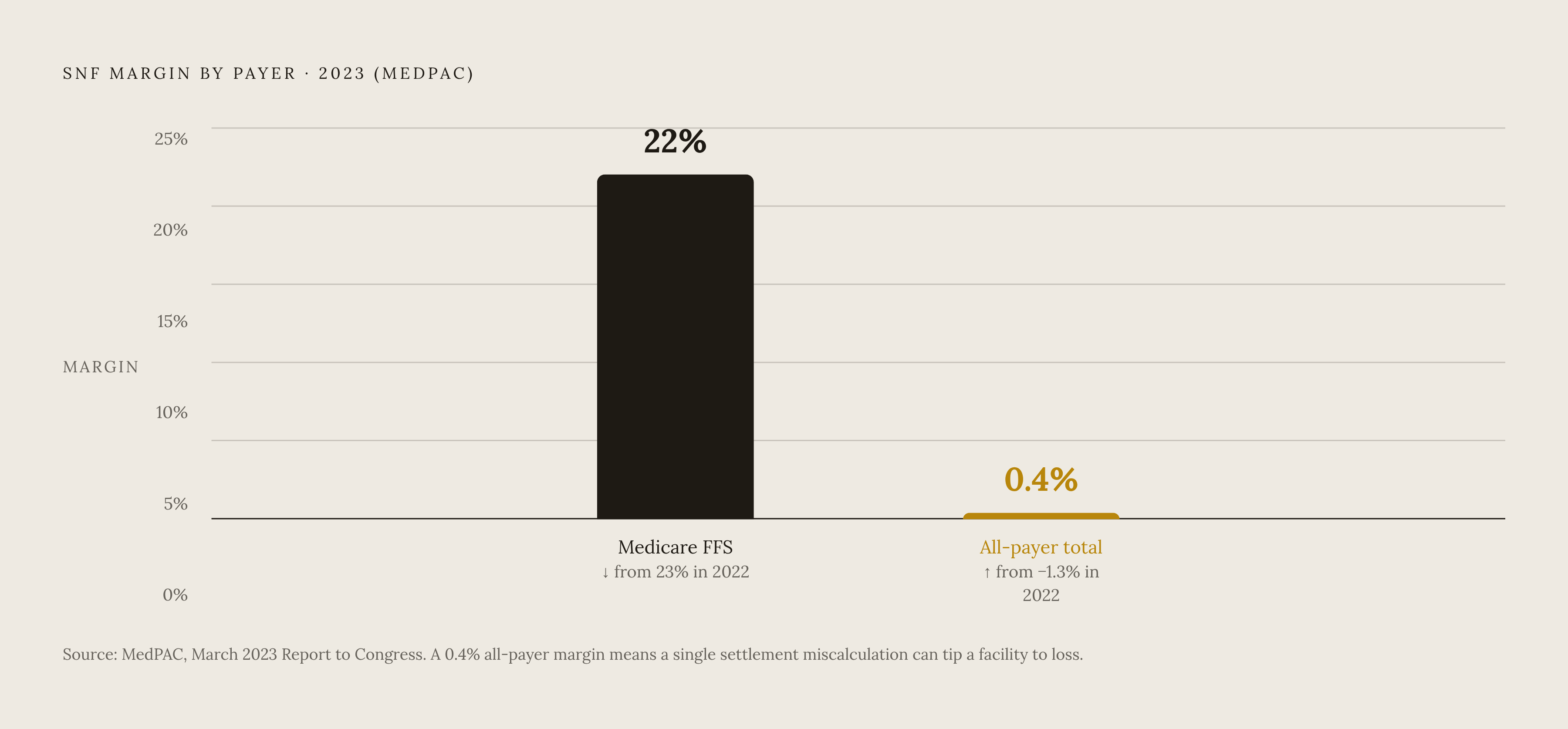
None of the mechanics above matter at the level of dollars and cents unless the margin picture explains why. It does: skilled nursing runs thin enough that a settlement error of even modest size can move a facility's bottom line by a meaningful amount.
Medicaid is the dominant payer by volume. Most patient days in most facilities are Medicaid days. Medicare fee-for-service covers a far smaller share of days but drives a disproportionate share of revenue, because its per-diem rates run substantially higher than Medicaid's. That gap explains why the FFS Medicare margin for freestanding SNFs, reported by MedPAC at 22% in 2023, down slightly from 23% in 2022, looks nothing like the picture across all payers combined. All-payer total margin improved from negative 1.3% in 2022 to a positive 0.4% in 2023, real movement in the right direction but still thin enough that a rounding error on a settlement receivable could tip a facility from marginally profitable to marginally not. MedPAC itself has flagged that even these figures may understate the complexity, given how tangled related-party arrangements make the underlying cost data.
Policy is not moving toward more room to absorb error. MedPAC voted unanimously, 17 to 0, to recommend a 3% reduction to Medicare payments for SNFs in fiscal year 2026, and further reductions in subsequent years have been under active policy discussion. A sector running on a 0.4% all-payer margin, with a 22% Medicare margin doing most of the work to keep it there, cannot afford to treat a settlement miscalculation as a rounding error. Staying open can depend on getting it right.
Disciplined settlement accounting across the settlement lifecycle
None of the preceding sections matter much if the accounting discipline behind them is loose. So what does careful practice actually look like, stage by stage, and where does it break down first when a facility gets sloppy?
At filing, the cost report has to tie back to the general ledger, cost center by cost center, with no unreconciled gaps left to explain away later. Every related-party transaction needs documentation showing it was recorded at the related organization's actual cost, not the invoiced amount, since those two figures are allowed to differ and often do. Where book depreciation and the depreciation basis allowed for Medicaid purposes run on different schedules, those schedules need to be kept separately, not reconstructed after the fact from memory when a reviewer asks for the reconciliation.
During desk review and tentative settlement, the facility should record a settlement receivable or payable based on its best estimate of where the tentative number will land, with the assumptions behind that estimate written down rather than calculated once and forgotten. During the audit phase, workpapers supporting every material cost allocation need to survive scrutiny on their own, independent of whoever originally prepared them. Open audit years should be tracked as contingent liabilities rather than left off the balance sheet, and accruals need to move as soon as audit adjustments are actually communicated, not months later at the next convenient close. That lag, waiting for a convenient close instead of booking the adjustment when it lands, is where most settlement accruals quietly go stale.
When retroactive payments land, the first question is always which period they belong to, and that question has to get answered before the cash gets booked as current-period revenue by default. The cost report gets filed once a year, but the accounting consequences of how it gets settled play out over several years, through rate cycles, through audit cycles, and through financial statements that either reflect that complexity honestly or paper over it with a number that felt close enough at the time. The margin data in the prior section is the reason that distinction is not academic: at a 0.4% all-payer margin, close enough is not actually close enough.
Sources
- Instructions
- Public Notice of Final Action for Setting Payment Rates for Long-term Care Facility Services | SCDHHS
- Nursing Facility Cost Report – Long-term Skilled Nursing Care | NC Medicaid
- March 2025 report to the Congress--Chapter 6: Skilled nursing facility services
- michigan.gov
- medicareadvocacy.org
- auditor.delaware.gov
- bonadio.com