Recognizing Revenue on Medicare Advantage Denials in SNFs
SNFs must account for Medicare Advantage denials as uncertain revenue under ASC 606 guidance.

Medicare Advantage now covers more than half of eligible Medicare beneficiaries, and skilled nursing facilities that treat those enrollees face a denial rate on admission requests that, in some cases, reaches a substantial share before appeal. The question this piece works through is not whether SNF operators can stop these denials, they largely can't, but how they should account for the revenue those denials put in question under ASC 606. Because a denied claim is not the same thing as a lost claim, and the accounting has to reflect that distinction with more precision than most facilities currently apply.
The scale here spans 35.2 million of the 64.2 million eligible Medicare beneficiaries enrolled in MA. KFF's enrollment data show MA now covers 35.2 million of the 64.2 million eligible Medicare beneficiaries, or 55%, up from 19% in 2007. The Congressional Budget Office projects that share climbing to 63%. Ninety-nine percent of MA enrollees are in plans that require prior authorization for a SNF stay, so prior auth is the default gateway nearly everyone has to pass through. An OIG review covering 19 Medicare Advantage Organizations (OEI-09-24-00331) found those plans collectively denied 12% of SNF admission requests in June 2024 alone, with individual MAO denial rates ranging from 23% down to 0.4%. A 2025 survey of 363 nursing home providers found two-thirds face MA denials or delays on a daily or weekly basis, and 67% report MA plans cutting off coverage against medical advice. Layer on top of that the 2.9 million beneficiaries who got displaced into new MA plans for 2026 because of plan exits and benefit restructuring, generating disruptions and denials that had nothing to do with medical necessity.
None of these numbers, added together, produce a single tidy statistic for "how much revenue is at risk." But the combined effect is that MA denial exposure has grown large enough to distort a SNF's reported revenue if it isn't handled with a defined, repeatable policy. A facility fielding dozens of denial notices a week cannot treat each one as its own isolated billing dispute. That approach doesn't scale, and it produces exactly the kind of inconsistent, undocumented judgment calls that auditors flag.
What the overturn data reveals about the true economic value of denied claims
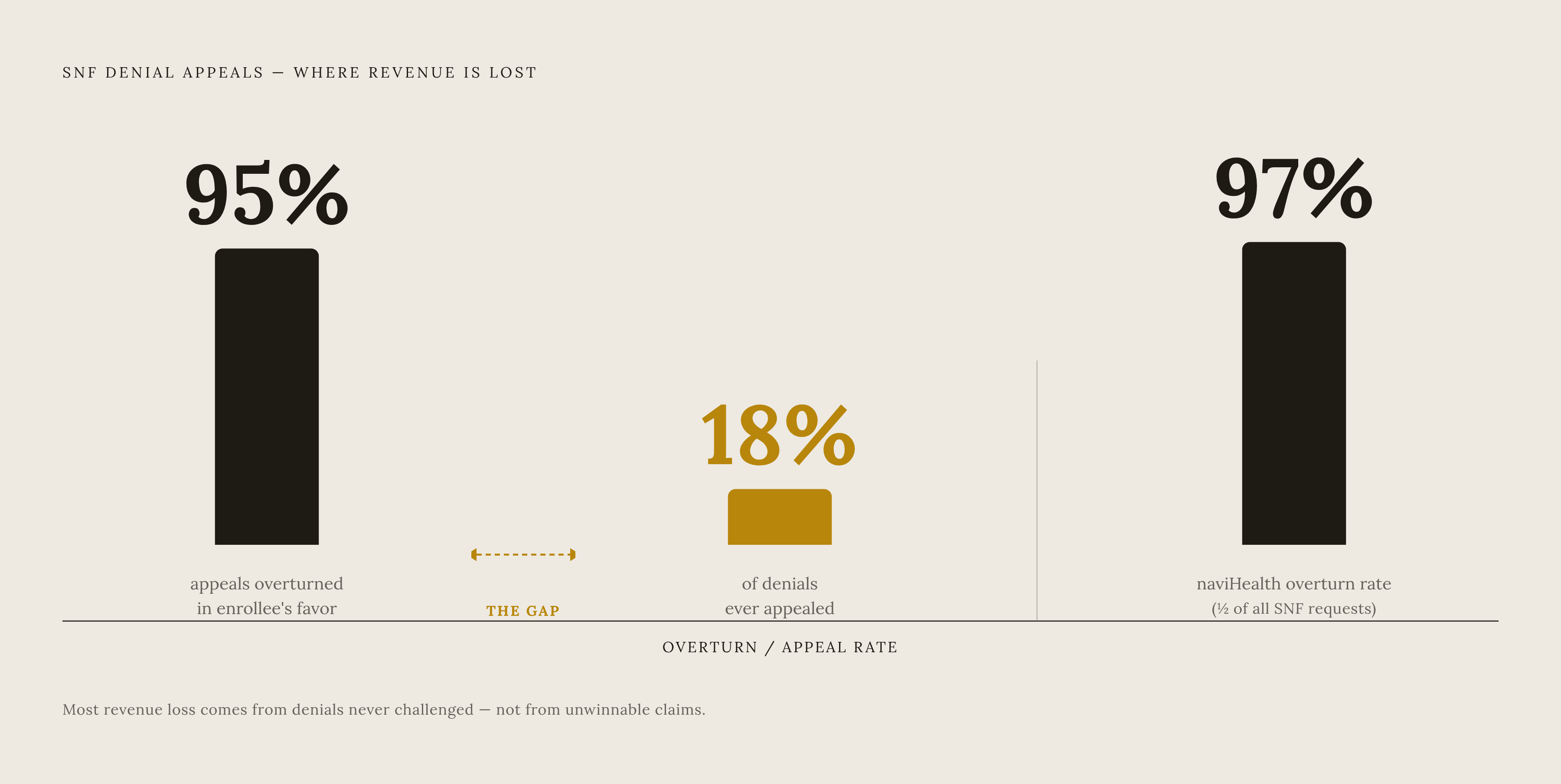
Start with the number that should reframe how any SNF finance team thinks about a denial letter: per the OIG review, when SNF denials were appealed, MAOs overturned 95% of them in favor of the enrollee. Ninety-five percent. That means in the overwhelming majority of appealed cases, the initial denial was wrong under the plan's own coverage criteria once someone with authority reviewed it a second time.
The same OIG report found that only 18% of SNF denials were appealed. Separate HIDA/KFF data on MA prior authorization denials broadly puts the appeal rate at 11.5%, with more than 80% of those appeals partially or fully overturned. So the pattern holds across data sets even if the exact percentages shift depending on which population is measured. The gap between what's winnable and what's actually appealed is where the real financial damage sits. Most of the value isn't lost because the claims lacked merit, it's lost because nobody filed the paperwork.
Some of this is contractor-specific, and the detail matters for anyone trying to model exposure by payer relationship. naviHealth, a UnitedHealth Group subsidiary, processed half of all SNF admission requests in the OIG's review period and denied 14% of them, a higher rate than MAOs handling review internally (11%) or other contractors (9%). Yet naviHealth's own SNF denials were overturned on appeal 97% of the time. That's not a footnote. If a facility's payer mix runs heavy on naviHealth-adjudicated claims, its expected recovery on denials should look meaningfully different than a facility whose denials come from a contractor with a lower overturn history.
Nursing home residents specifically faced a 40% denial rate, versus 11% for other Medicare Advantage enrollees, and the same high-overturn pattern applies to that population too. For long-stay facilities, that compounds the exposure considerably. One more wrinkle from the OIG data: for-profit plans denied SNF access more often than non-profit plans, suggesting financial incentive plays some role in denial behavior, separate from clinical judgment.
Put the two headline figures side by side. Ninety-five percent overturn on appeal. Eighteen percent appeal rate. A denial, in this environment, is an unresolved claim that, more often than not, still has economic value attached to it. It's an unresolved claim that, more often than not, still has economic value attached to it. The amount of that value to recognize, and when, becomes the accounting issue. ASC 606 was built to handle this.
How ASC 606 classifies MA reimbursement as variable consideration
Under ASC 606, the contract with the customer, in a SNF setting, runs between the provider and the patient. Under this framework, the separate agreement with the Medicare Advantage plan sets what the payer will reimburse on the patient's behalf. That distinction matters because it clarifies what the SNF is actually estimating: not "what does the contract say we're owed," but "what will we collect given everything currently known about this specific claim's path through authorization, audit, and appeal."
That's the definition of variable consideration. ASC 606-10-32-6 states that consideration is variable when it can change because of discounts, rebates, refunds, credits, price concessions, incentives, performance bonuses, penalties, or similar items, or when the entity's entitlement to it depends on some future event occurring or not occurring. MA reimbursement fits that definition about as cleanly as any transaction type in health care accounting, because the amount a SNF ultimately collects depends on whether prior authorization holds up, whether a post-payment audit clears the claim, and whether an appeal, if filed, succeeds.
There's a second layer of variability that often gets underweighted: RAC audit exposure. Under post-payment audit rules, claims can be flagged for recoupment years after payment if a reviewer later decides the service wasn't medically necessary, wasn't covered, or wasn't documented properly. That three-year tail means a claim that looked clean and fully collectible at the time of billing can still generate a downstream revenue adjustment well after the reporting period closes. That retroactive risk is also variable consideration, and it doesn't disappear just because the initial payment posted without incident.
Where does the amount a SNF doesn't expect to collect go, accounting-wise? Under ASC 606, it gets treated as an implicit price concession, a reduction to the transaction price itself. That's a classification difference. Bad debt expense appears differently on the income statement than a reduction to revenue, and a lender or auditor reading the top line draws different implications from each. Because implicit price concessions don't appear as a separate line on the face of the financial statements, entities should think seriously about disclosing the aggregate amounts in the notes, so a reader isn't left guessing at how much of gross revenue got quietly netted down.
ASC 606 also requires disclosure sufficient to let financial statement users understand the nature, amount, timing, and uncertainty of revenue and cash flows tied to contracts with customers. For a SNF with material MA exposure, that generally means disaggregating revenue by payer type and laying out the significant judgments behind the constraint estimates, rather than folding everything into a single net revenue figure and hoping nobody asks how it was built.
Applying the variable consideration constraint: when to recognize, constrain, and release MA denial revenue
The operative constraint rule under ASC 606 holds that variable consideration only gets included in the transaction price to the extent it's probable that a significant reversal of cumulative revenue recognized won't occur later. That's the constraint, and it's the mechanism that keeps a SNF from booking optimistic revenue today that has to be clawed back next quarter.
At the point of service delivery, the standard actually leaves room for two different approaches depending on the facility's own history. If a SNF has a strong, well-documented track record of collections from a given MA payer, a predictable pattern of collectability, it can recognize revenue at or near the contracted rate right away. Absent that kind of pattern, revenue gets recognized on actual cash collected. There's no universal default here; it depends on what the entity's own data supports.
The interesting judgment calls start once a denial actually lands. A denial creates a contingent event, the outcome of a future appeal, and that contingency typically constrains the variable consideration, either fully or partially. Castle Biosciences' fiscal year 2025 10-K offers a useful illustration of how one entity handled this exact scenario, describing variable consideration tied to claims under appeal as "typically deemed to be fully constrained due to factors outside the entity's influence, including judgment or actions of third parties." Management has to decide, claim by claim or category by category, whether to constrain fully (recognize nothing on the denied piece until resolution) or partially (recognize a probability-weighted amount grounded in historical overturn data).
That raises the question at the center of this entire framework: given that 95% of appealed SNF denials get overturned, does a facility's own historical appeal success rate amount to a "predictable pattern of collectability" strong enough to justify recognizing some portion of denied revenue before the appeal even resolves? There's no blanket answer. It depends entirely on the SNF's own data, not industry-wide averages, because the standard is explicit that the pattern has to be entity-specific. A facility with three years of appeal outcomes segmented by payer has a much stronger basis for partial recognition than one relying on a national overturn percentage that says nothing about its own payer mix or its own appeal discipline.
When an appeal succeeds and payment is received or firmly committed, the constraint releases. Castle Biosciences' disclosure describes this as cash collections triggering "the related recognition of revenue in the current period for services delivered in prior periods due to the release of the constraint." That phrasing points to a discipline that's easy to get wrong in practice: when a constraint releases, the revenue belongs to the period the service was actually delivered, not the period the cash showed up. Recognizing it in the wrong period misstates both, the prior period that should have carried more revenue and the current period that's now carrying revenue that isn't really its own.
Each reporting period, these estimates get re-evaluated, and adjustments flow through as increases or decreases to current revenue, not as prior-period corrections, unless the original estimate was wrong enough to cross the materiality threshold for restatement. And when a claim gets abandoned without an appeal ever being filed, the SNF still has to decide whether that uncollected amount is an implicit price concession, an adjustment baked into the transaction price, or a genuine bad debt. The distinction sounds technical, but it changes how the amount is presented and what gets disclosed around it.
What auditors examine when reviewing a SNF's MA denial revenue estimates
An auditor walking into this territory is going to start with completeness, and the direction of the error matters as much as its existence. Are denied-but-not-yet-appealed claims properly constrained under the standard, or has management already written off revenue it's reasonably likely to collect given its own historical overturn rate? Under-recognition is an error just as much as over-recognition is, even though it feels more conservative and therefore safer.
From there, the review moves to the adequacy of the reserve methodology itself. Does management's constraint approach rest on the facility's own historical claims data, segmented by payer and claim type, or does it lean on industry-wide averages that might not reflect this particular facility's payer mix, appeal habits, or contractor exposure? Recall that the 19 MAOs in the OIG review had denial rates spanning from 23% down to 0.4%. A facility whose census skews toward the highest-denial plans is carrying materially different variable consideration risk than one whose census skews toward low-denial plans, and a constraint methodology that treats them identically won't hold up well under scrutiny. naviHealth's 97% overturn rate is exactly the kind of entity-specific evidence an auditor would want to see reflected in the numbers: if a meaningful share of a SNF's denials trace back to naviHealth, the constraint applied to those specific claims should account for that overturn history rather than defaulting to a flatter, more conservative assumption.
Auditors will also test whether constraint releases, meaning successful appeals, land in the correct period. The concern is straightforward: is revenue from a successful appeal being recorded in the period the service was actually delivered, as the standard requires, or is it getting swept into the current period in a way that flatters current results at the expense of accuracy?
Internal control gaps occur here too, and they tend to be less about accounting judgment and more about operational follow-through. Authorization details that get communicated to billing late or incorrectly create denial-driven revenue leakage that a post-payment audit may be the first to catch. Failing to track when an authorization needs renewal, failing to follow up on a denial within whatever window the payer allows for appeal, failing to shift the right portion of a balance to patient coinsurance or a secondary payer, each of these is a control weakness with a direct line to a misstated revenue estimate.
Disclosure sufficiency rounds out the review. Does the note disclosure actually describe the nature and scale of MA-related variable consideration, the significant judgments behind the constraint estimates, and the methodology used to disaggregate revenue by payer type, or does it gesture at the topic without giving a reader enough to evaluate the estimate independently?
Auditors have to assess whether that reduction needs to be accrued now or simply disclosed as a contingency, which is its own judgment call sitting alongside the MA denial estimates.
Taken together, the combination of a high denial rate, a low appeal-filing rate, and a 95% overturn rate on the claims that do get appealed creates conditions where management's estimates are unusually exposed to bias in either direction, too optimistic and overstating revenue, or too conservative and writing off value the facility was actually going to collect. That's the profile of a significant estimate area, and it deserves to be treated as one.
Building the internal infrastructure that makes defensible MA denial accounting possible
None of the constraint analysis in the prior sections works without data, because a SNF that isn't tracking denial volume by MAO, by claim type, by appeal filing rate, and by appeal outcome isn't estimating anything. A SNF that isn't tracking denial volume by MAO, by claim type, by appeal filing rate, and by appeal outcome isn't estimating anything, it's guessing, and dressing the guess up in ASC 606 language doesn't make it defensible.
What does the minimum infrastructure actually look like? A denial log segmented by MAO or contractor is the starting point, and naviHealth-sourced denials belong in their own category given how different that overturn profile is from the rest of the field. An appeal filing rate tracked against a real benchmark matters too: the OIG found that only 18% of SNF denials get appealed industry-wide, so a facility sitting below that mark is leaving revenue on the table that the data says is provably recoverable. Historical overturn rate, broken out by payer and by claim type, is the entity-specific evidence the standard actually asks for. And an authorization renewal calendar closes the loop on the front end, catching lapses before they turn into denials that never needed to happen.
Some of the operational gaps that erode this infrastructure are well documented: authorization details that reach billing late or inaccurately, denials that sit without follow-up, post-payment audit responses that come in past the window. Each of those gaps translates, eventually, into an accounting estimate that can't survive audit testing, because the underlying data simply isn't there to support it.
The 2.9 million beneficiaries displaced into new MA plans for 2026 represent a live, current risk. Facilities need a process for identifying, ahead of time, which residents had prior authorizations invalidated by a mid-year plan change, so those denials get caught and routed correctly before they distort the revenue ledger rather than after.
For SNFs carrying a complex MA payer mix, or a large population of long-stay nursing home residents facing that 40% denial rate, these variable consideration estimates aren't a minor footnote, they're material to the financial statements. That argues for a review by auditors who actually know the SNF sector in operational detail, not just ASC 606 in the abstract: auditors who understand skilled nursing reimbursement structures, CMS Quality Reporting Program obligations, and the financing structures common to the industry, HUD 232 among them. A financial statement audit built around that kind of sector knowledge does more than check a compliance box. It surfaces the specific revenue recognition risks laid out across this piece, tests the constraint methodology against the facility's own historical data rather than a borrowed industry average, and gives ownership and lenders a real basis for confidence that the revenue on the books reflects what the facility is actually going to collect.
Sources
- Medicare Advantage Plans Frequently Deny Skilled Nursing Facility Coverage
- Medicare Advantage Organizations Overturned Nearly All Appealed Prior Authorization Denials for Skilled Nursing Facility Admission, Raising Concerns About Initial Denials
- Medicare Advantage Insurers Deny Prior Authorization Requests for Post Acute Care at Substantially Higher Rates Than the Overall Denial Rate | KFF
- 247medicalbillingservices.com